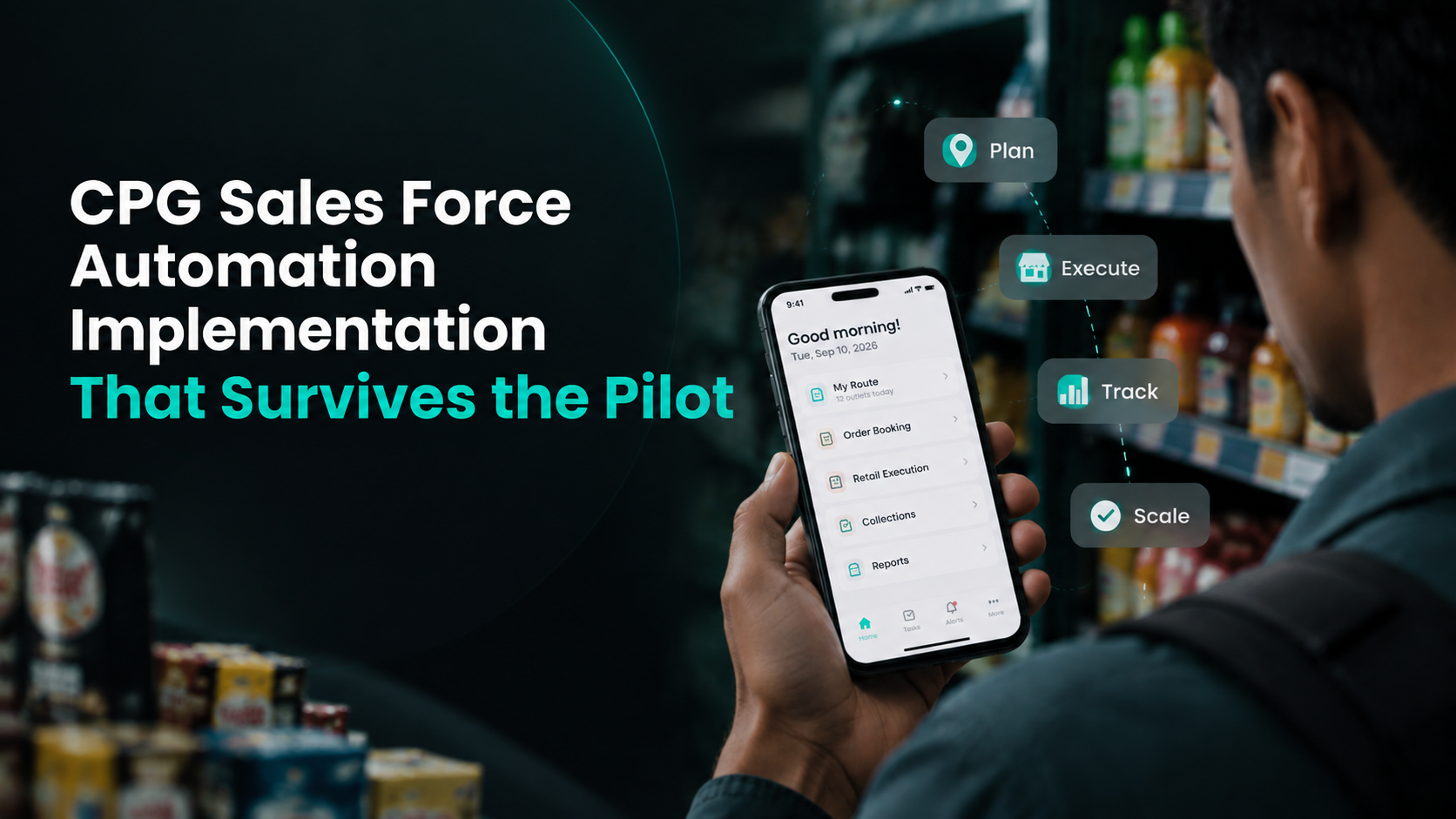
Most CPG sales force automation pilots impress the boardroom. Few survive contact with the full field force.
A practical guide to SFA implementation for CPG sales and IT leaders. Updated September 2026.
Sales force automation (SFA) software is technology that replaces the manual routines of a field sales team (order booking, beat planning, retail execution reporting) with a single mobile-first system. For most CPG companies, that shift starts small: one region, one team, a few hundred outlets. SFA implementation for CPG is the harder project underneath the pilot: making that same system work for every region, every distributor, and every rep on the roster.
A pilot succeeds because the conditions are unusually forgiving: a handful of motivated reps, clean sample data, a manager watching closely. Almost none of that survives contact with 3,000 outlets, a distributor network with its own quirks, and a rep who has done the job the old way for eleven years. The gap between a good pilot and a good rollout is where most CPG sales-tech projects actually get decided, and it's the gap this guide is written for.
Key Takeaway
Analysts at Gartner estimate that 55 to 75 percent of ERP and other large enterprise software rollouts fail to meet their objectives. A CPG SFA implementation carries the same structural risk the moment it moves past a small, forgiving pilot.
What is sales force automation, and why does SFA implementation start at the pilot?
Sales force automation is the category. SFA implementation is the project: the actual work of taking that category from a demo to a system 3,000 field reps use every day, on real outlet and distributor data. An AI-Native SFA platform can look identical in a pilot and a full deployment. What differs is everything behind the screen: data volume, integration depth, and how many people have to change a habit at the same time.
A full SFA implementation, as distinct from a pilot, typically covers four things:
Data cleanup and migration: outlet master, distributor mapping, and historical sales history validated before go-live, not after.
ERP, DMS and CRM integration: order, inventory and collections data flowing both ways, not just captured inside the app.
Manager-first training: field managers trained and actively using the system before reps are asked to trust it.
A phased go-live plan: region by region or role by role, with a defined checkpoint to pause and fix before the next wave.

A pilot and a full SFA implementation can run the same software on very different foundations.
The same three foundations look very different once the pilot ends. What actually changes between the two:
None of the right-hand column is usually tested in a pilot. A pilot's whole appeal is that it skips the hard parts, which is also why it tells a CPG company so little about whether the implementation will hold once it reaches the full field force.
Why do CPG SFA pilots stall before full-scale field sales automation?
Pilots rarely fail outright. They stall: the pilot "worked," but the business never quite greenlights the next 3,000 users. Five patterns show up again and again in CPG sales-tech rollouts:
Manager adoption lags rep rollout. Reps mirror what their managers actually reference in daily coaching, not what a training deck said in week one. When managers skip the system, so do their teams.
Data carried over uncleaned. Outlet records and distributor mappings that were "good enough" for 50 pilot users start producing errors that erode trust once the same gaps hit 5,000.
No pre-agreed scale-or-kill metric. Without a business number decided in advance, the call to scale becomes a political debate rather than an evidence-based one.
Change management treated as a single training event. One onboarding session doesn't hold up against a role that has to change a daily habit; it needs role-based reinforcement over weeks, not a one-time deck.
Integration debt. Connections to ERP, a distributor management system, or a CRM that were stubbed out or run manually for the pilot become the bottleneck the moment real order volume depends on them.
The framework: the 4 gates every SFA rollout must clear
A pilot answers one question: does the software work for a few people? A rollout answers a harder one: is the whole organisation ready to run on it? Four gates decide that. Treat each as pass or fail, not a rough sense of progress.
Outlet, distributor and sales history validated at full volume, not sample size.
Managers already using the system in their daily coaching, ahead of reps.
ERP, DMS and CRM connections load-tested at real order volume.
The one business number you agreed on has actually moved in the pilot.
The rule
All four gates green, or the rollout waits. One red gate is enough to hold: scaling past it does not fix the problem, it multiplies it across the full field force.
The checklist: what to verify before you scale past the pilot
The gates are the test. This is how you pass them, in order. The sequence matters: each step de-risks the next, and the metric gate sits in the middle as a genuine go or no-go, not a formality at the end.
The metric gate is a real decision point, not a rubber stamp at the finish line.
Run a data clean-up sprint before go-live. Validate the outlet master, distributor hierarchy and historical sales data as its own tracked workstream, not a footnote to the software rollout.
Get managers using the system first. Sequence manager adoption ahead of rep rollout, and make system data part of every coaching conversation before asking reps to trust it.
Set the scale-or-kill metric in advance. Pick one business number (visit compliance, order accuracy, secondary sales visibility) and agree, before the pilot starts, what result greenlights the next 3,000 users.
Load-test integrations at full volume, not pilot volume. Confirm ERP, DMS and CRM connections can handle real order and inventory volume before the wider rollout depends on them.
Build role-based training into the rollout plan, not before it. A rep, a manager and a distributor need different training, delivered close to their own go-live date rather than one generic session months earlier.
Phase the rollout deliberately. Go region by region or role by role, with a defined checkpoint to fix problems before the next wave, rather than a single big-bang launch.
What SFA implementation looks like on an enterprise SFA platform
Timelines vary by scope, but a consistent pattern holds across CPG SFA rollouts: a standard deployment typically runs 6 to 12 weeks, while a highly customized, enterprise-wide rollout can take 3 to 6 months. The first measurable wins usually show up in visit compliance and order accuracy, the two metrics that close fastest once paper is replaced by a mobile-first system.
A typical 12-week standard deployment. Heavily customized, enterprise-wide rollouts extend this to 3 to 6 months.
The slower, harder-won proof is full field-force coverage on a unified SFA and DMS platform, rather than a patchwork of tools stitched together to make the pilot look clean.
What that looks like once it's no longer a pilot:
Frequently asked questions about CPG SFA implementation
What is SFA implementation?
SFA implementation is the project of taking sales force automation software from a limited pilot to a system used by the full field sales team, across every region and distributor, backed by clean data and working integrations to ERP, DMS and CRM systems.
How long does SFA implementation take for a CPG company?
Standard SFA deployments typically take 6 to 12 weeks. Highly customized, enterprise-wide rollouts with heavy integration work can take 3 to 6 months. Most CPG teams see their first measurable gains in visit compliance and order accuracy well before the full rollout is complete.
Why do CPG SFA pilots fail to scale?
Pilots usually succeed under unusually forgiving conditions: a small, motivated team, clean sample data, and close manager attention. They stall at scale when managers haven't adopted the system ahead of reps, when outlet and distributor data wasn't cleaned before go-live, or when there was no metric agreed in advance for deciding whether to scale.
What should be verified before scaling an SFA pilot to the full field force?
Confirm the data is clean at full volume, managers are already using the system in coaching conversations, integrations with ERP, DMS and CRM are load-tested for real order volume, and there is a pre-agreed business metric that justifies moving to the next phase.
Is SFA implementation different from a distributor management system (DMS) rollout?
SFA and DMS solve different problems (field sales execution versus distributor operations), but they share the same outlet, distributor and order data, and usually need to be implemented together. A unified SFA and DMS platform removes one integration point that a standalone rollout would otherwise have to build and maintain.
What is the single biggest predictor of whether an SFA pilot scales?
Manager adoption ahead of rep rollout. Field reps consistently follow what their managers reference in daily coaching rather than what a training deck said in week one, so pilots where managers use the system first tend to scale faster and with less resistance.
See what SFA implementation looks like once it's past the pilot.
Talk to SalesCode about a rollout built for the field force you actually have, not the one in the demo.
Book a Demo