
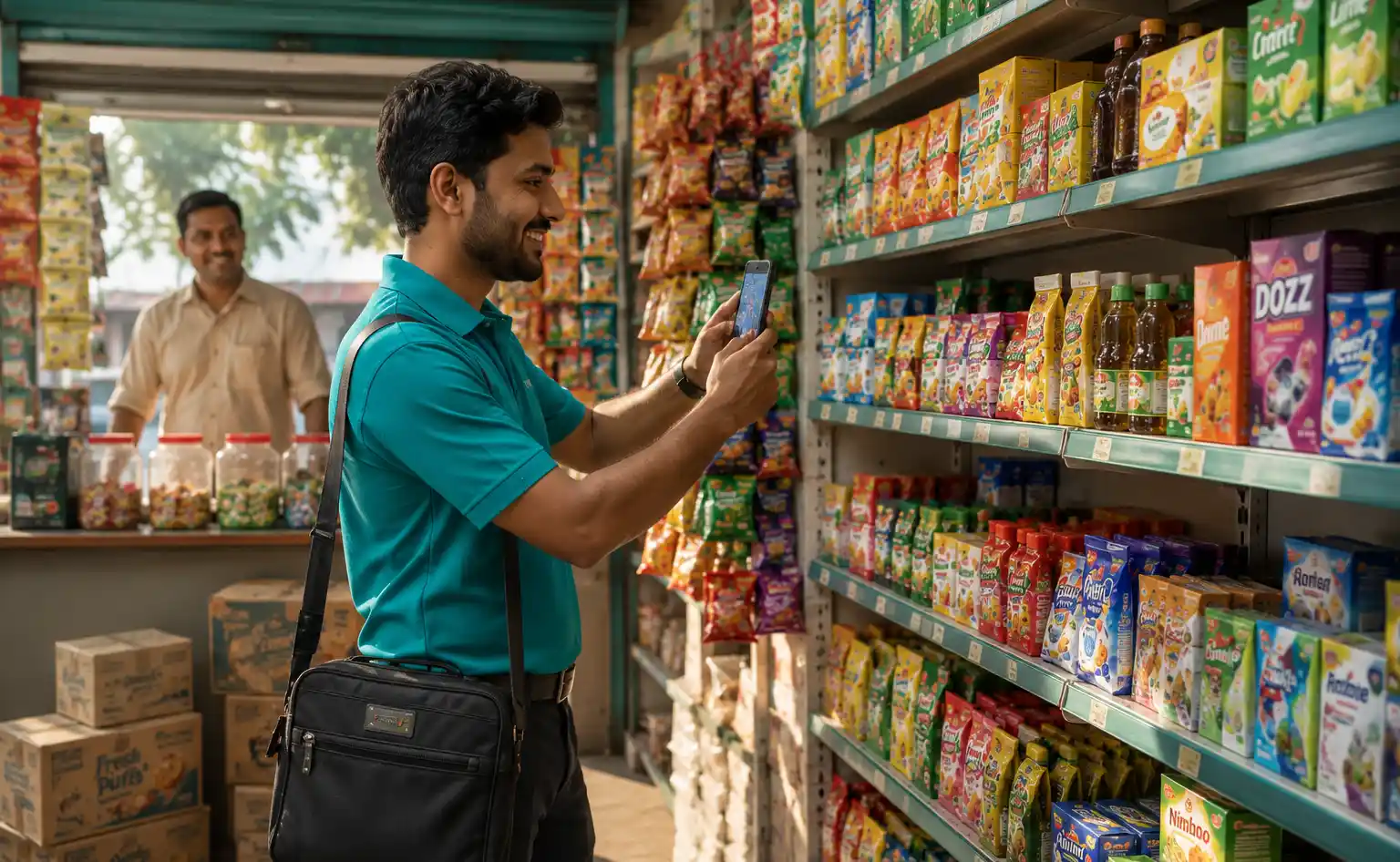
The image recognition pilot always works. That is the problem. In a pilot you have twenty hand-picked reps who know they are being watched, a project manager chasing them daily, one clean product list, and three cooperative outlets per rep. Every one of those conditions disappears the day you scale to four thousand reps. Here is the direct answer. Image recognition programmes in FMCG rarely fail because the recognition engine is inaccurate. They fail on six things that sit entirely outside the model: capture discipline, image quality, master data, the operating model, the gap between output and action, and measurement. Fix those and a mediocre engine delivers. Ignore them and the best engine in the world gives you an expensive photo archive. This is for the sales or trade marketing leader who has signed off on IR, seen a pilot go well, and is now about to roll it out across a real field force.
The short answer
Most IR failures are programme failures, not technology failures. The six that account for nearly all of them: reps stop capturing once the attention moves on, image quality degrades until accuracy claims stop holding, the SKU master was never clean enough to recognise against, nobody decided whether the rep or the retailer holds the camera, the output arrives as a score instead of a task, and no baseline was set so nobody can prove it worked. Every one of those is decided by you, not by your vendor.
Key takeaways
- A pilot tests the engine. A rollout tests your operating discipline. They are different exams and passing the first predicts very little about the second.
- Capture rate, not accuracy, is the number that kills most programmes. A perfect model that sees 40 percent of your outlets is worth less than a decent one that sees 95 percent.
- Your SKU master is the hidden dependency. Recognition can only be as good as the catalogue it matches against.
- The compliance score is not the deliverable. The store-level task is.
- If you did not set a baseline before go-live, you have bought a system you cannot defend at renewal.
What the pilot had that the rollout will not
The single most useful exercise before scaling is to list the conditions your pilot enjoyed and ask which ones survive. Most rollout failures are simply the predictable consequence of those conditions disappearing. In the pilot, reps were hand-picked, closely monitored, and highly motivated. After rollout, image capture becomes just one more task for thousands of reps already managing a full beat. Supervision also changes from a dedicated project manager tracking every capture to an ASM balancing multiple TSIs and sales targets. The environment changes too. A curated SKU list becomes the full product master with duplicates and dead codes. Cooperative pilot stores become every kirana on the PJP, including difficult outlets. Reliable connectivity becomes basement shops, metal shutters, and rural dead zones. Read these as a risk register. Every one is a point where a successful pilot can become a stalled rollout.
Why reps stop capturing photos once the attention moves on
Because photo capture is unpaid work added to a beat that was already full, and nothing in the rep's day rewards it. In the pilot the reward was attention. When the attention moves to the next project, the behaviour goes with it. The pattern is consistent. Capture rates hold for the first few weeks, then drift. Reps start photographing the easy outlets and skipping the crowded ones, which are precisely the outlets where execution is worst and the data matters most. You end up with a dataset biased toward the shelves that were already fine. The fix is not a reminder email. It is making the capture part of a task the rep already has a reason to complete, tied to something they care about: their incentive, their KPI, their target. When shelf capture sits inside the daily task list in the AI Native SFA rather than in a separate app, and completing it credits the rep immediately, the behaviour holds without anybody chasing it. Ask your vendor a blunt question before you sign. Not "what is your accuracy?" but "what happens on day 45 when my reps stop taking photos?" The answer tells you whether they have run a real rollout or only a pilot.
Why image quality quietly destroys your accuracy numbers
Because a benchmark accuracy figure describes the model, not the photograph your rep actually took. A model measured at [94.2 percent mAP50 on the SKU-110K benchmark, running on-device at zero inference cost](https://salescode.ai/products/retail-image-recognition/general-trade) is a real number. It is also a number obtained on properly framed images. In a real kirana, the rep is standing too close because there is no room to step back, shooting at an angle because a customer is in the way, in mixed light with a shutter half down. Recognition does not fail loudly on those images. It fails quietly, reading a gap where a facing exists or missing the bottom row entirely, and the resulting out-of-stock report goes into a dashboard as fact. This is the most damaging failure mode on the list, because it does not look like a failure. It looks like data.
“An IR programme that reports a stockout that was never there does not just waste a rep's time. It teaches your field force that the system is wrong, and once they believe that, they stop acting on any of it.”
The countermeasure is validation at the point of capture: guidance while the rep is framing the shot, a quality check before the image is accepted, and a recapture prompt when the scan falls below threshold. Validation that happens back at head office, hours later, is too late to be useful.
Why your SKU master decides whether IR works at all
Because recognition is a matching problem, and it can only match against the catalogue you gave it. This is the dependency nobody puts in the project plan, and it fails more rollouts than any model limitation. Most FMCG SKU masters carry years of accumulated debris. Codes for packs that were delisted two years ago. The same variant entered twice under different descriptions after a distributor migration. New pack sizes launched by the marketing team that never made it into the master. Your competitor's products, which you need to detect for share of shelf, are usually absent entirely. Legacy platforms hid this problem inside a long setup phase, where somebody spent weeks photographing every SKU from multiple angles before the system worked at all. Zero-image setup removes that runway, which is a genuine improvement. It does not remove the need for a clean catalogue. The two are different problems and only one of them belongs to your vendor. Do the master data audit before the rollout, not during it. Deduplicate, retire dead codes, tag your priority SKUs and your must-order lines, and decide which competitor products you actually need to see.
Who should hold the camera, the rep or the retailer?
This is an operating model decision, not a technical one, and leaving it undecided is itself a failure mode. Both models work. They fail differently. Rep capture gives you control, route alignment and verified presence in the store. It costs you rep time on every visit, and it caps your frequency at whatever the permanent journey plan allows. If a rep reaches an outlet once a fortnight, that is how often you see the shelf. Retailer capture gives you frequency that no field force can match, and it costs almost no rep time. It depends entirely on retailer willingness, which in practice means it depends on whether there is something in it for them, usually a loyalty credit or a visible benefit in their ordering app. Most large networks end up hybrid: reps in the outlets where execution is contested and the numbers justify the time, retailer-led capture in the long tail. Decide this before go-live and design the incentives around it. Programmes that leave it open discover six months in that nobody owns the capture rate.
Why a compliance dashboard does not move a single case
Because a score tells you the shelf was wrong, and nothing in that sentence changes the shelf. This is where the largest number of IR programmes end up: technically live, reporting accurately, and commercially invisible. The chain has to close. A photograph becomes a detection, a detection becomes a specific instruction for a specific store, the instruction reaches the person who can act while they are still standing in that store, and the result is checked on the next visit. Break any link and you have bought analytics, not execution. Here is the test worth applying. Take last week's IR output and ask what a named rep did differently in a named outlet because of it. If the honest answer is that the regional manager saw a lower compliance percentage in a Monday review, the loop is not closed. The score went up the hierarchy when the instruction needed to go sideways into the rep's task list. This is the distinction that separates AI Native IR from a reporting tool: the output is a storelevel execution task, not a number. A missing must-order line detected on the shelf should arrive as a task with the SKU already in the cart, not as a percentage in a report.
How to tell whether the programme actually worked
By setting a baseline and a control before go-live, which almost nobody does. Once the system is live everywhere, the comparison you need no longer exists. Three things to fix in advance.
- Define the metric once, in writing. On-shelf availability, share of shelf and planogram compliance all sound self-evident and are all measured differently by different teams. Agree the definition before anybody reports against it.
- Hold out a control group. A set of comparable routes that do not get IR for the first quarter. Without it, you will be arguing about seasonality and a competitor's promotion for the rest of the programme's life.
- Measure the sales outcome, not the compliance outcome. Compliance rising is a leading indicator. It is not the point. The question at renewal will be whether secondary sales moved on the routes where execution improved.
That last one is uncomfortable, and it is the right question. A programme that improved compliance by fifteen points and moved no volume has told you something important about which shelves actually mattered.


