
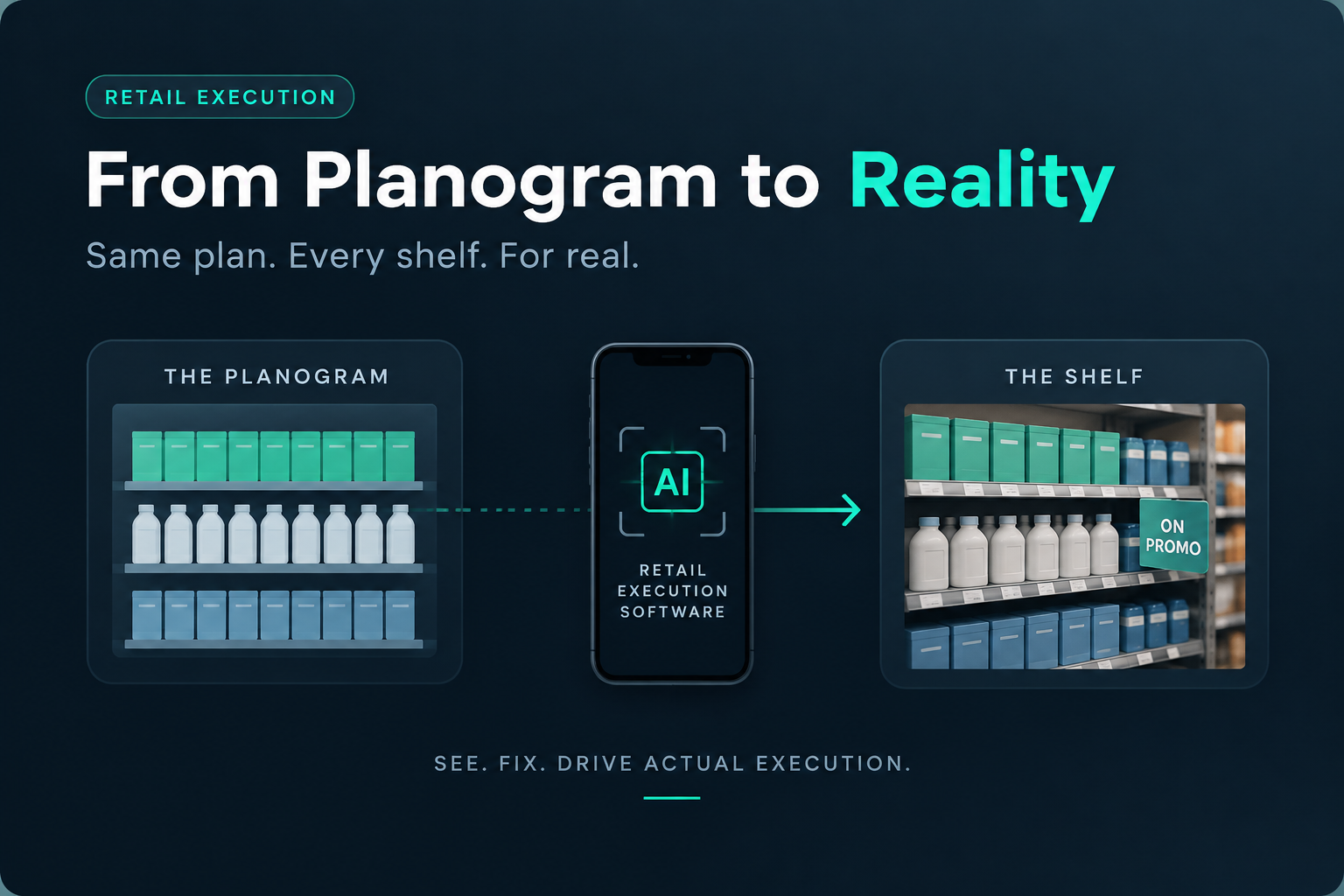
The planogram is perfect. The shelf, three states away, is not. The whole job of retail execution is closing the distance between the two.
A trade-marketing guide for CPG sales and shelf-execution leaders. Updated September 2026.
Retail execution software is the system that makes sure what a brand planned for the shelf is what actually appears on it: the right SKUs, faced correctly, in the planogrammed position, with the promotion live. The plan is designed once at head office. The shelf is re-decided every day by a store associate filling a gap, a rep in a hurry, and a competitor rep quietly widening their block. Retail execution software exists because those two versions of the shelf drift apart, and the drift is expensive.
This is a concrete look at that gap: why the shelf leaves the plan, how big the gap runs, and the loop that closes it while the rep is still standing in the store, instead of a compliance report that lands a week too late.
Key Takeaway
Industry data puts planogram compliance in large chains at just 50 to 70 percent, meaning roughly one shelf in three does not match the approved layout at any given moment. That gap is an execution problem, not a design problem, and design tools cannot fix it.
What is retail execution software, and why does the shelf drift from the plan?
Retail execution software plans, tracks and verifies what happens at the point of purchase: availability, planogram compliance, share of shelf, pricing and promotion. The shelf drifts from the plan for ordinary reasons. A store associate fills an empty slot with whatever is to hand. A rep self-reports compliance from the one tidy aisle. An out-of-stock forces a substitution that quietly breaks the layout. None of it is dramatic, and that is the problem: it is invisible until a sales report catches it weeks later.
The modern answer reads the shelf directly. SCAI Vision is Salescode's on-device image-recognition system that reads a shelf photo to measure availability, share of shelf, and planogram compliance, running on the phone at zero inference cost. It is an example of AI-Native Image Recognition (AI-Native IR), which differs from a manual audit in what it can actually do at the shelf edge:
Most image-recognition tools promise the world, then hand you a 6 to 8 week setup, endless image training, and a cost that is never affordable, especially in traditional trade. On-device AI-Native IR is built to answer each of those in turn:
Store-level display and visibility tasks, created in 3 clicks. Image training for new SKUs, done in 3 clicks. Task execution tracking, live in 3 seconds. No seed images, no months of retraining.
The difference in the last row is the one that matters. A manual audit produces a report. Retail execution software worth the name produces the fix.
How big is the planogram-to-shelf gap?
The gap is not a rounding error. Industry research on on-shelf availability keeps landing on the same picture: a large share of shelves are off-plan, much of the missing product is sitting in the same store, and the shopper does not wait when the facing is empty.
Shelf shown for illustration. Figures are directional industry estimates, three different measures, not one audited study.
Read together they tell one story. A third of shelves are off-plan, a large slice of the missing product is sitting in the very same store, and when a shopper meets an empty facing the majority simply buy a rival. The plan did its job. The shelf did not, and nobody at head office knew in time to act.
The loop that closes the gap: capture, detect, act, prove
Closing the gap is not a reporting problem, it is a loop. A compliance score tells you the shelf was wrong after the rep has left. A closed loop turns what the camera sees into a fix while the rep is still standing there. The four steps run in one visit, not one reporting cycle, which is the whole point.
The point
Your IR should give you a sales lift, not just a score. The loop only counts if step 3 happens in the same visit as step 1, which is why detection has to run on the phone, in seconds, offline.
What the gap looks like on the shelf
None of this is abstract to a trade-marketing team. The gap has a face, and it is the same six scenes in store after store. Each one breaks a specific metric, and each one is exactly what an on-device read of the shelf is built to catch in the moment.
The eye-level SKU that slid to the bottom shelf
A premium variant that was planogrammed at eye level is now down by the floor, outsold by whatever took its place. The inventory system still says it is available, so nothing flags it.
Breaks: Planogram complianceThe end-cap that never went up
The display was funded, invoiced and reported as live. It was never built. The spend went out, the lift never came, and the only proof either way was a rep's word.
Breaks: Promo executionThe empty facing the system swears is in stock
Phantom inventory: the stock is in the back room or mislabelled, the shopper sees a gap, and a large slice of stockouts are exactly this, product in the store that never reached the shelf.
Breaks: On-shelf availabilityThe competitor block that grew into your space
A rival rep quietly added two facings a visit until your planogrammed share was gone. Nobody decided it. It accumulated, and a manual audit that only checks presence never caught it.
Breaks: Share of shelfThe tidy-aisle photo that passed as compliant
The self-reported shelf photo was taken in the one bay that looked right. The other four were not. Compliance read green, and the gap stayed invisible until the numbers dipped.
Breaks: Compliance integrityThe new SKU that launched everywhere except the shelf
The listing went through, the trade spend was committed, and the SKU still is not on the shelf in a third of stores. A launch is only real when the shopper can see it.
Breaks: On-shelf availabilityFrequently asked questions about retail execution software
What is retail execution software?
Retail execution software plans, tracks and verifies what happens at the point of purchase: on-shelf availability, planogram compliance, share of shelf, pricing and promotion. Its job is to close the gap between the shelf a brand planned at head office and the shelf a shopper actually sees, and increasingly it reads that shelf with on-device image recognition rather than manual audits.
Why do shelves drift from the planogram?
Everyday store reality: associates fill gaps with whatever is to hand, out-of-stocks force substitutions, competitor reps expand their facings, and compliance is self-reported from the tidiest aisle. Industry data puts planogram compliance in large chains at 50 to 70 percent, so about one shelf in three is off-plan at any moment. The causes are execution, not design.
How does image recognition improve retail execution?
A rep photographs the shelf and the software reads availability, share of shelf and planogram compliance in seconds, then turns each miss into a task to fix before the rep leaves. SCAI Vision runs this on-device at 94.2 percent mAP50 accuracy on the SKU-110K benchmark, so the feedback is a fix in the same visit, not a report a week later.
What is a good planogram compliance rate?
Compliance is the share of audited stores whose shelves match the approved layout. Large chains commonly sit at 50 to 70 percent, and a rate below about 85 percent is generally treated as a direct revenue leak rather than a cosmetic issue. The route to a higher rate is more frequent, verified measurement, which manual audits cannot deliver at scale.
Can retail execution image recognition work offline in general trade?
Yes, if the model runs on the phone. On-device AI-Native IR processes the shelf photo locally at zero cloud inference cost, so it works in a low-signal kirana store and returns results in seconds. Cloud-only tools stall exactly where general trade lives, which is why on-device processing matters more than raw model size.
How is retail execution software different from a manual shelf audit?
A manual audit is periodic, self-reported and subjective, and it produces a report after the visit. Retail execution software with on-device image recognition is continuous, verified and objective, and it produces a task during the visit. The difference is not better reporting; it is acting on the shelf while it can still be fixed.
See the shelf the way SCAI Vision does.
Watch on-device AI-Native IR read a real shelf, score compliance, and turn the miss into a task, in one visit, offline.
Book a Demo


