
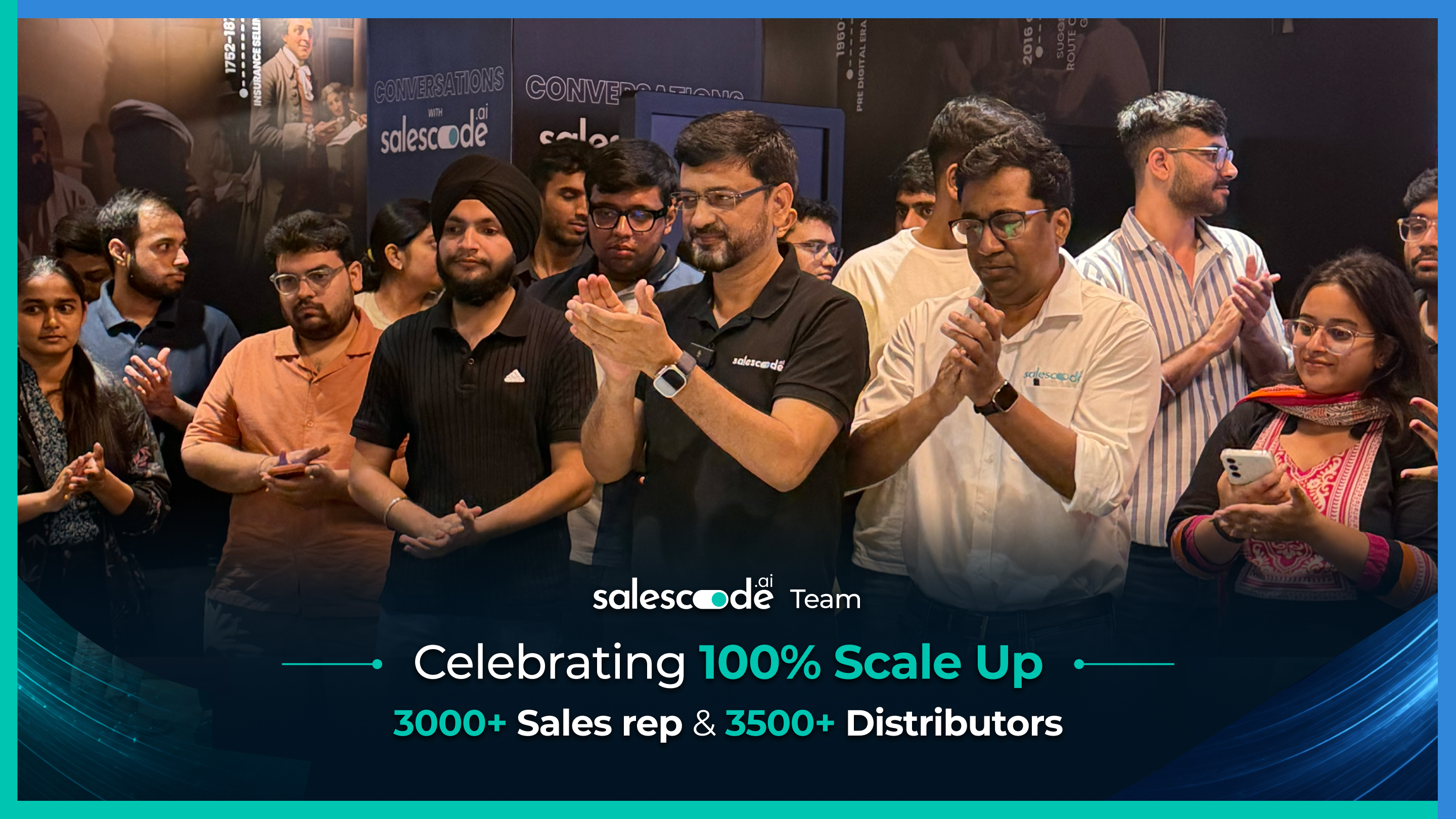
How CavinKare migrated 3,000+ reps and 3,500+ distributors to AI-Native SFA and DMS, retiring a 10-year platform to hit 100% scale-up with zero disruption.
An AI-Native SFA and DMS transformation replaces the field-sales (SFA) and distributor-management (DMS) systems that run a consumer-goods company's route-to-market with a single, intelligence-led platform — one that doesn't just record what sold, but decides what to do next. CavinKare did exactly this: it migrated 3,000+ sales reps and 3,500+ distributors off a mature, decade-old DMS to reach 100% scale-up without disrupting a single day of operation, in one of the largest AI-Native SFA and DMS transformations the CPG industry has seen.
This is the full story of that route-to-market transformation — the conviction it took to replace a working system, the industry backdrop that made it urgent, the approach that made it safe at scale, and the replicable playbook it leaves for any FMCG leader sitting on a legacy distributor management system they are afraid to touch.
Why replace a distributor management system that already works?
Most transformation stories begin with a system that failed. CavinKare's began with one that worked. The company was running a mature, stable, decade-old distributor management system from one of the most established providers in the industry — software that had served the business reliably for years. Replacing a broken tool is an easy call anyone can defend. Replacing a working one is a decision that takes conviction, because every incentive in the organisation argues for leaving it alone.
This is the central tension of the CavinKare story, and it is worth naming precisely, because it is the exact decision thousands of FMCG leaders are avoiding right now. The incumbent DMS was built for a previous era — engineered to record transactions, not to drive intelligent decisions. A system that was state-of-the-art ten years ago can keep running flawlessly and, at the very same time, quietly cap what the business is able to see and do. The risk of change was real and visible; the cost of standing still was real and invisible. The Situation–Complication–Resolution arc below traces how that tension resolved.
The decision becomes clearer when you plot it on the two variables that actually govern a replatforming call: how healthy the current system is, and how much conviction leadership has to change. Most organisations only act in the bottom-left — replace a system once it is visibly failing. CavinKare acted in the top-right, the hardest and rarest quadrant, and the one where durable competitive advantage is actually built.
The state of FMCG distribution technology in 2026How SalesCode ran a zero-disruption SFA and DMS migration at fullThe state of FMCG distribution technology in 2026
CavinKare's conviction looks even sharper against the market it sits in. Consumer-goods distribution is in the middle of a technology re-platforming. The digitalization of FMCG was valued at roughly USD 110 billion in 2025 and is projected to reach USD 300 billion by 2033, a 15% CAGR, according to market-research estimates — and the distributor management system category alone is forecast to grow to about USD 12.46 billion by 2033 at a 7.4% CAGR. Distribution technology is no longer a back-office line item; it is where consumer-goods competition is now being decided.
Yet the spend is not translating into results, because most of the installed base is stuck at an earlier stage of maturity. Industry analyses put the scale of the gap plainly: an estimated 43% of sales teams never fully adopt their SFA or CRM software, and Bain's consumer-goods sales research has found that only about half of consumer-products executives see a clear link between corporate strategy and what actually happens in the field. A legacy distributor management system that merely records transactions produces, in the words of one industry analysis, "noise with a dashboard on top."
Most consumer-goods brands are parked at stage two — a functional but backward-looking DMS — and the twin forces of quick commerce and AI are widening the distance to the leaders every quarter. That is the competitive context in which CavinKare decided not to upgrade one rung, but to jump the ladder: from a transaction-recording distributor management system to an AI-native platform for both sales force automation and distribution.
How SalesCode ran a zero-disruption SFA and DMS migration at full scale
A migration of this size fails in one of two ways. It stalls before it starts, because the risk feels too large to commit to — the "status quo" trap. Or it goes live and breaks the business it was meant to improve, because implementation was mistaken for adoption. The industry is full of the second failure: recall that implementation and adoption are not the same thing, and that a DMS which is installed but not fully used becomes "just another reporting tool filled with incomplete or delayed data." CavinKare and SalesCode designed the programme specifically to avoid both traps.
The core principle was to treat the move as a joint transformation, not a software swap — with both teams matching each other step for step through design, deployment and scale-up. The AI-Native SFA and DMS migration ran as a sequenced, three-phase process rather than a single high-risk cutover.
Phase 1 — Design around the business, not the software. The two teams first mapped the transformation across CavinKare's different business units and roles, so the platform fit how the company actually sells and distributes before a single user was moved. This is the step that pre-empts the 43% adoption-failure trap: adoption is designed in, not hoped for.
Phase 2 — Deploy a unified platform, not stitched tools. Rather than bolting separate sales force automation and distributor management systems together, CavinKare moved onto a single unified SFA + DMS platform — built on 25+ AI-Native modules and 12+ AI agents designed to drive sales and distribution, not merely log them.
Phase 3 — Scale to 100% without downtime. The teams then migrated thousands of users across roles and a 3,500+ distributor network into full production — without disrupting a single day of operation. Successful migration was one milestone; seeing the AI-Native SFA and DMS platform operate flawlessly at full scale was the one that mattered.
Framing the choice as a decision matrix shows why the unified AI-native path won on every axis that mattered to the business — not just capability, but cost-of-staying, adoption risk and time-to-value.
What changed: from a legacy DMS to AI-Native route-to-market
The clearest way to see the value of this transformation is as a bridge between two operating states — from a system that recorded what happened to a platform that helps decide what happens next. This is the same leap the whole consumer-goods category is now trying to make, which is what makes CavinKare's before-and-after a useful reference point for any FMCG leader planning a distributor management system or sales force automation upgrade.
The results: 100% scale-up with zero disruption
The headline outcome is a full-scale migration the business never felt. Every rep and every distributor moved to the new AI-Native SFA and DMS platform, and CavinKare's distribution ran without interruption throughout. Against an industry backdrop where 43% of teams never fully adopt their sales software, reaching 100% scale-up is the result that most distinguishes this transformation.
What makes the result stand out is the degree of difficulty. This was not a greenfield rollout or the rescue of a failing system. It was the planned replacement of a mature, industry-standard distributor management system — the kind of project most organisations postpone precisely because the incumbent still works. Completing it at 100% scale, with zero disruption, is why both companies describe it as one of the largest AI-Native SFA and DMS transformations in the CPG industry.
Just as important is what the outcome sets up. By moving from a transaction-recording DMS to an AI-native platform for sales force automation and distribution, CavinKare closed the strategy-to-field gap that Bain found affects half of consumer-goods leaders — replacing "noise with a dashboard on top" with a single, adopted source of truth from primary order to secondary sale.
What this means for FMCG leaders running a legacy DMS
Most FMCG and CPG leaders are in some version of CavinKare's starting position: a distributor management system that was best-in-class a decade ago, still runs, and is quietly capping what the business can see and do. With the digitalization of FMCG on a 15% CAGR and quick commerce compressing decision cycles, the "status quo" quadrant is getting more expensive every quarter. The CavinKare transformation offers a replicable playbook for deciding — and executing — the move to AI-Native SFA and DMS.
Judge the system by what it enables, not whether it runs. "It still works" is not the bar. A distributor management system that only records transactions carries a real opportunity cost — the strategy-to-field gap Bain measures — even when it never goes down. Score the cost of staying, not just the risk of switching.
Unify SFA and DMS, don't stitch them. Moving field sales and distribution onto one unified SFA and DMS platform is the structural advantage point tools can't match — one source of truth from primary order to secondary sale, so rep activity and distributor stock reconcile automatically instead of in a month-end spreadsheet.
Design adoption in; don't confuse go-live with adoption. The 43% adoption-failure rate is a design problem, not a training problem. Mapping business units and roles before migration is what turns a 65%-adoption "dashboard on noise" into a 100%-adoption source of truth.
Sequence the migration; zero disruption is a plan, not luck. A full-scale route-to-market migration the business never feels comes from a phased design-deploy-scale process, not a big-bang cutover.
Conviction on both sides is the real prerequisite. Replacing a working system takes a customer willing to bet on what's next and a partner willing to match that commitment step for step. The technology is necessary; the partnership is what makes it land at scale.
Frequently asked questions
An AI-Native SFA and DMS transformation replaces a company's legacy field-sales (SFA) and distributor-management (DMS) systems with a single, AI-driven route-to-market platform. Instead of separate tools that record transactions, one platform uses AI agents to help plan, sell and distribute. CavinKare used this approach to migrate 3,000+ reps and 3,500+ distributors to 100% scale-up.
Because "still works" isn't the same as "still competitive." A decade-old DMS built to record transactions can run perfectly and still hold the business back by offering no real-time intelligence — the strategy-to-field gap Bain found affects about half of consumer-goods leaders. The opportunity cost of staying, not the risk of switching, is why leaders like CavinKare move to an AI-native platform.
Yes. CavinKare moved 3,000+ sales reps and 3,500+ distributors across different business units and roles to a new AI-Native SFA and DMS platform and reached 100% scale-up without disrupting a single day of operation. Zero-disruption at this scale comes from a phased design-deploy-scale approach — designing around real units and roles first, then scaling.
A unified SFA and DMS platform gives one source of truth from primary order to secondary sale, which point tools stitched together cannot. It removes the reconciliation and data gaps that come from running sales force automation and distributor management on different systems — the structural advantage behind CavinKare's transformation.
Because implementation is mistaken for adoption. An estimated 43% of sales teams never fully adopt their SFA or CRM software, so the system becomes a reporting tool filled with incomplete data. The fix is to design adoption in — mapping business units and roles before migration — which is how CavinKare reached 100% scale-up rather than a partial rollout.
It is one of the largest AI-Native SFA and DMS transformations in the CPG industry — and it replaced a mature, working, industry-standard DMS rather than a failed one, at 100% scale with no operational disruption. That combination of scale and degree of difficulty, in a distribution-technology market growing at a double-digit CAGR, is what sets it apart.


