
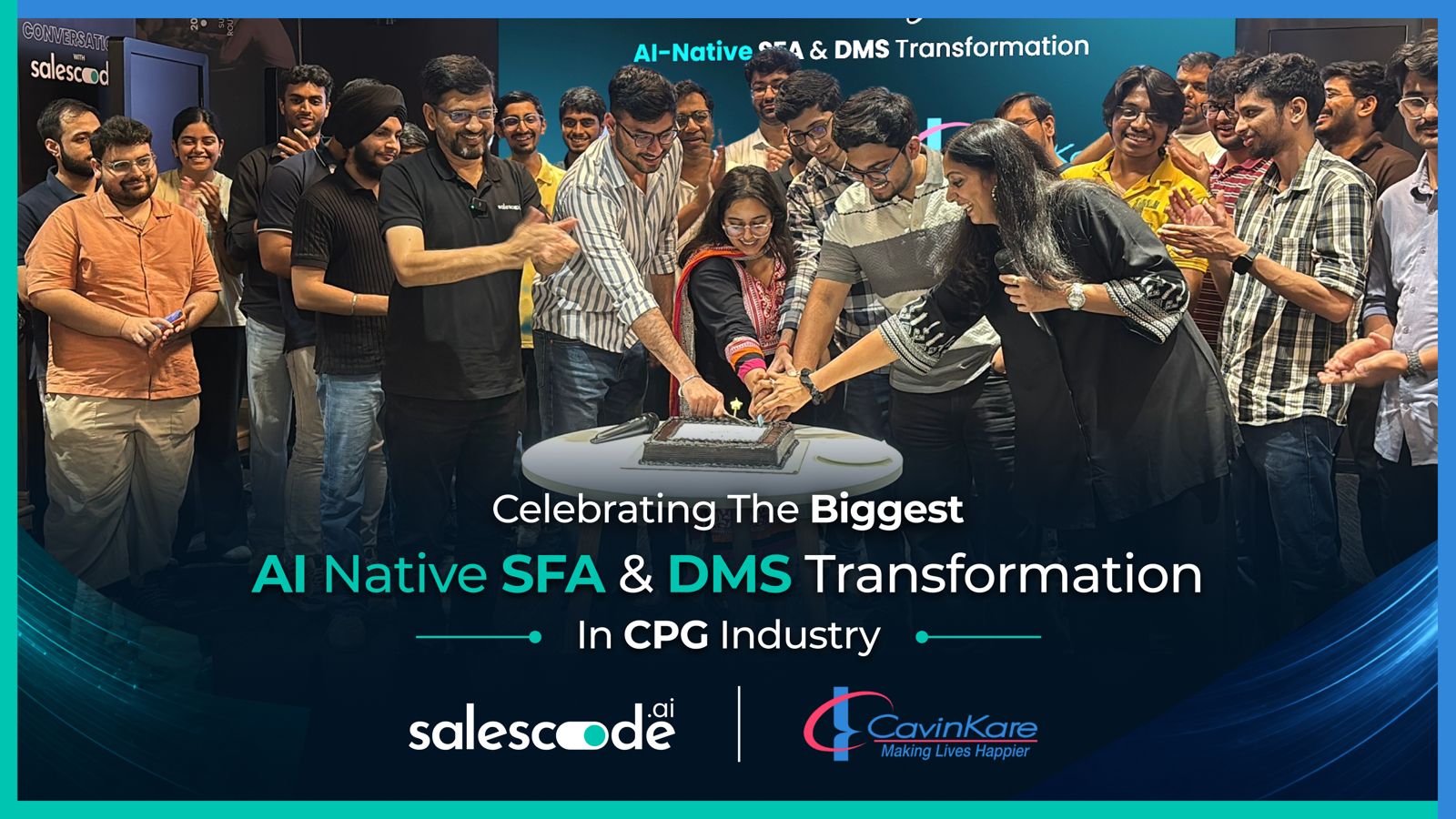
One of CPG's largest AI-Native SFA & DMS transformations — thousands of users moved off a decade-old platform to 100% scale-up.
SalesCode Team · Updated August 13, 2026 · 8 min read
When a leading FMCG company decides to rebuild its sales force automation (SFA) and distributor management system (DMS), the hard part is rarely the technology — it's the conviction to leave a working system behind. CavinKare made that call. It retired a platform that had run its route-to-market for a decade and migrated thousands of users onto SalesCode.ai's AI-Native SFA and AI-Native DMS — completing one of CPG's largest AI-Native SFA and DMS transformations at 100% scale-up. Here's how the migration worked, and what it means for CPG sales leaders weighing the same move.
The hardest transformations aren’t the ones fixing something broken. They’re the ones where a customer has the conviction to leave behind what’s comfortable and bet on what’s next.
CavinKare’s existing platform had served the business well for a decade. This migration was different on three counts:
- It replaced a system that worked. The goal wasn’t to fix failure — it was to move to AI-native selling before the market forced the change.
- It spanned multiple businesses. Thousands of users across different CavinKare businesses moved together, not one pilot team.
- It was a full switch, not a trial. The decade-old platform was retired, not run in parallel indefinitely.
For a CPG enterprise, leaving a stable decade-old system is the harder, riskier call — and the one that unlocks AI-native selling.
Why Replace A Working SFA and DMS Platform?
Most SFA and DMS transformations start with something that's broken. This one didn't. CavinKare's existing platform had served the business well for a decade. The decision to move to an AI-native platform was different on three counts — and each one is the reason the migration mattered.
It replaced a system that worked. The goal wasn't to fix a failing SFA or DMS — it was to move to AI-native selling before competitors did.
It spanned multiple businesses. Thousands of users across different CavinKare businesses migrated together on one route-to-market programme — not a single pilot team.
It was a full switch, not a trial. The decade-old platform was retired, not run in parallel indefinitely.
For a CPG enterprise, replacing a stable decade-old SFA and DMS is the harder, riskier call — and the one that unlocks AI-native selling.
How do SFA and DMS stay in sync at 3,000-rep scale?
The question a KDM asks about an SFA and DMS transformation isn't what the two systems are — it's whether they'll actually reconcile once thousands of reps and distributors are live on them. At CavinKare's scale, three things decide that, and they're where most SFA-DMS projects quietly break.
Order-to-billing reconciliation. A secondary order a rep captures in SFA has to land in the distributor's billing in DMS without a monthly Excel match. On one AI-native platform they share a data model, so field demand and distributor billing reconcile automatically instead of drifting apart.
Master-data alignment. Outlet, product, and distributor codes have to mean the same thing in both systems, or every report needs manual cleanup. Unifying that master data across 3,000+ reps and 3,500+ distributors was foundational to the migration — it's what lets call data, secondary sales, and billing tie out.
Distributor adoption. Industry-wide, a large share of sales teams never fully adopt the software they're given — and distributors are the hardest to move. Reaching 100% scale-up meant getting every distributor active on DMS, not just every rep on SFA.
At enterprise scale, SFA-DMS success is decided by reconciliation, master data, and distributor adoption — not by the features in a demo.
Migrating 3,000+ reps and 3,500+ distributors to one platform
Scale was both the challenge and the achievement. Moving both systems — for every user, at once — is what made this one of CPG's largest AI-native transformations.
3,000+ sales reps migrated to AI-Native SFA for outlet coverage, order capture, and in-store execution.
3,500+ distributors onboarded to AI-Native DMS for inventory, orders, and secondary sales visibility.
Multiple businesses transitioned in a single coordinated route-to-market programme.
100% scale-up — full adoption on the new SFA and DMS, not a partial rollout.

Months of joint work through design, deployment and scale-up brought both teams to 100% SFA and DMS adoption.
How the SFA and DMS migration reached 100% scale-up
An SFA and DMS implementation at this scale succeeds only when the customer's team commits as fully as the vendor's. The programme moved through four clear phases.
Design. Mapping CavinKare's multi-business route-to-market onto AI-Native SFA & DMS workflows.
Deployment. Rolling the platform out to reps and distributors, business by business.
Scale-up. Driving adoption until every rep and distributor was active on the new stack.
100% cut-over. Retiring the decade-old platform once full scale-up was confirmed.

The SalesCode.ai team at the joint celebration of 100% scale-up.
Why SFA and DMS belong on one AI-native platform
The reason CavinKare moved both systems together, not one at a time, is the same reason FMCG leaders increasingly want SFA and DMS integration on a single platform. When the two run on separate systems, primary and secondary sales drift apart, and execution gaps open up where the data doesn't reconcile — a stockout at a distributor stays invisible to the rep serving that territory until it's too late.
On one AI-native platform, that gap closes. This is the case for SFA DMS integration: rep activity, distributor stock, and secondary sales share a single data layer — field orders reflect at the distributor level instantly. That shared data is what lets an AI-native system move from reporting what happened to guiding what should happen next.
Integrated SFA and DMS on one AI-native platform is what turns a decade-old, report-only stack into predictive, guided execution.
Two Teams, Two Cities, One Cake-cutting
Some milestones deserve cake. This one deserved two — cut together, 2,200 km apart. After months of building the new SFA and DMS together, both sides still hadn't celebrated in the same room, so the teams did it differently: two locations, one video call, one shared cake-cutting.
CavinKare's team celebrated at their office while the SalesCode.ai team celebrated at ours — connected live, raising a toast to the 100% scale-up achieved together.
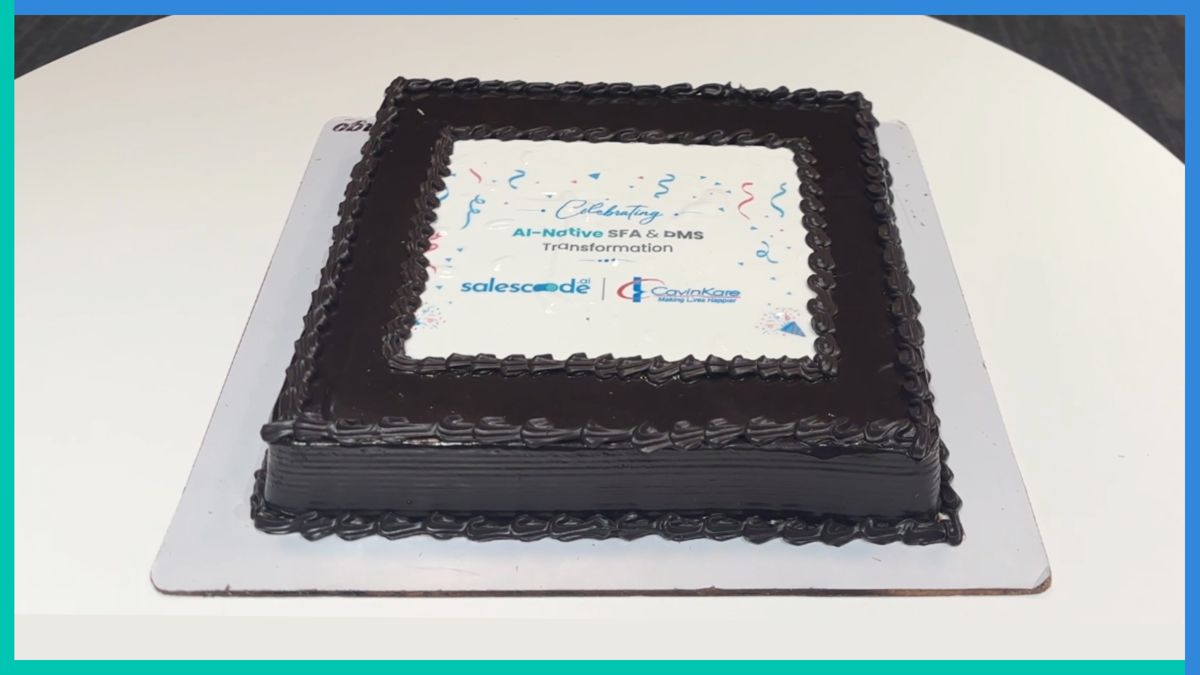
One of two cakes — cut together over a live video call, 2,200 km apart.
What This Means For CPG and FMCG Sales Leaders
CavinKare's move is a signal for the wider industry: AI-Native SFA and DMS is now proven at enterprise scale, even as a migration off a mature, decade-old system. If you're weighing a sales force automation or distributor management system transformation, three lessons carry over.
The barrier is rarely the technology. It's the conviction to leave a comfortable, working SFA and DMS behind.
Adoption is a partnership, not a hand-off. Full scale-up needs the customer's team as committed as the vendor's.
Scale is achievable in one programme. Thousands of reps and distributors across multiple businesses can move together — and reach 100%.

CavinKare — "Making Lives Happier" — is one of India's best-known CPG houses.
Frequently Asked Questions
What is an AI-Native SFA and DMS transformation?
It's the migration of a company's field sales force automation (SFA) and distributor management system (DMS) onto an AI-native platform, where AI drives the workflows rather than being bolted on top. For CavinKare it meant moving 3,000+ reps and 3,500+ distributors off a decade-old system onto SalesCode.ai's AI-Native SFA and DMS, reaching 100% adoption.
How do SFA and DMS stay reconciled at enterprise scale?
The risk in any SFA and DMS transformation is that field orders and distributor billing drift apart, forcing monthly manual reconciliation. On one AI-native platform they share a single data model, so a secondary order captured by a rep flows into distributor billing automatically — with aligned outlet, product, and distributor master data so call data, secondary sales, and billing tie out without cleanup.
Why would an FMCG company replace a working SFA and DMS platform?
Because the goal is to move to AI-native selling before the market forces it, not to fix a failure. A decade-old platform can still work, but an AI-native SFA and DMS unlocks predictive execution, better secondary sales visibility, and a unified route-to-market a legacy stack can't deliver.
How long does an enterprise SFA and DMS migration take in FMCG?
For a migration of this scale it took months of the CavinKare and SalesCode.ai teams working together through four phases — design, deployment, scale-up, and 100% cut-over — until every rep and distributor was active on the new platform.
What does 100% scale-up mean in an SFA and DMS rollout?
It means full adoption rather than a pilot or partial rollout. Every user migrated: 3,000+ sales reps onto AI-Native SFA and 3,500+ distributors onboarded to AI-Native DMS, across multiple CavinKare businesses on one coordinated programme.
Why should SFA and DMS be integrated on one platform?
SFA captures demand at the outlet while DMS converts it into fulfilled, billed supply at the distributor. When they run as one AI-native platform, primary and secondary sales reconcile on a shared data layer, closing the execution gaps — like a distributor stockout invisible to the field rep — that separate SFA and DMS systems leave behind.
Planning your own AI-Native SFA & DMS transformation?
See how SalesCode.ai unifies AI-Native SFA, DMS, eB2B and AI Sales Agents into one route-to-market platform — with a maximum 3% sales uplift guarantee.
Book a demo →


