
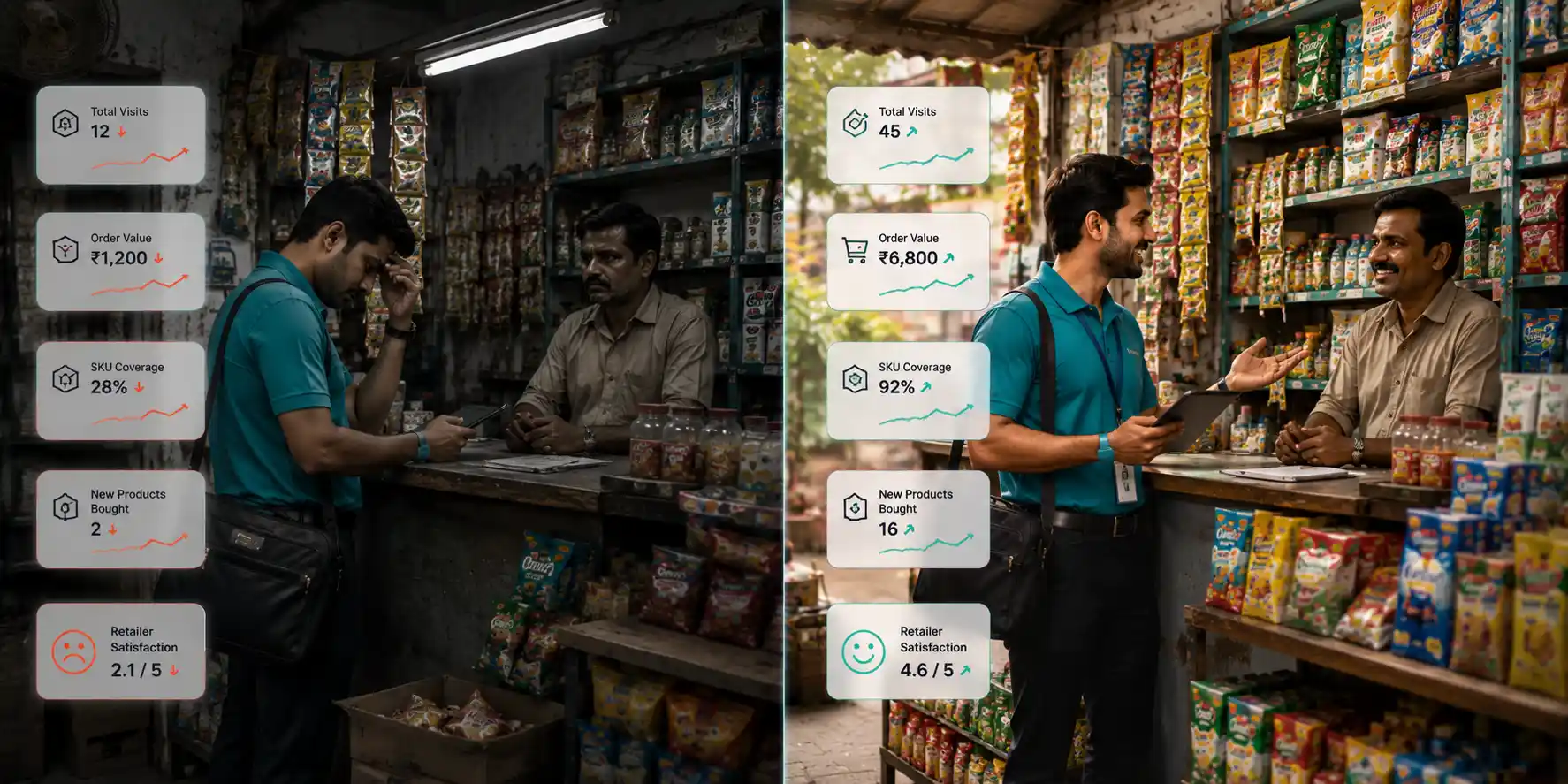
Two reps work the same beat in the same town. Same brands, same price list, same trade schemes, same distributor. One does substantially more secondary sales than the other, month after month. For 27 years I have watched FMCG companies explain that gap with one word. Talent. That word has cost this industry more money than any competitor ever has. Because it treats a measurable, fixable, two-variable problem as a personality trait you can only hire around. Here is the direct answer. A high-performing field rep is not more talented. They are strong on two independent things at once: whether they can sell (capability) and whether they are selling (effort). Measured across 65,000 plus field reps at 22 plus CPG companies over 24 months, almost every underperforming rep is short on one of those two, rarely both. They look identical on a sales report. They need opposite interventions. This piece is for the sales leader who has a bottom quartile they cannot explain, and a training budget they are not sure is working.
The short answer
SKILL × WILL is Salescode's framework that scores every field rep on two axes: capability (SKILL) and motivation (WILL), to target coaching and predict performance. SKILL is measured from outcome KPIs such as strike rate, SKU per order, and average order value. WILL is measured from effort data such as visits per day, start time, and time spent in store. Across 65,000+ field reps at 22+ CPG companies, tracked for 24 months, 96% of top performers sit in the high SKILL, high WILL group, and every 5% shift into that group is worth 3–8% more sales. The practical consequence is simple: Before you coach a rep, identify whether the missing factor is SKILL or WILL.
Key takeaways
- Rep underperformance is two different problems wearing the same uniform: a capability gap or an effort gap. A monthly sales report cannot tell them apart
- SKILL shows up in outcome KPIs. WILL shows up in behaviour data. You almost certainly already collect both, in two systems that do not talk to each other.
- High performance is almost never one axis alone, which puts a hard ceiling on any programme aimed at capability or motivation in isolation.
- Sending a low-effort rep to a selling-skills workshop is the most common and most expensive misdiagnosis in FMCG field sales.
- The diagnostic is worth running before the next training cycle, not after it
Is your rep's problem capability or effort?
It is one or the other, and the difference decides everything you do next. A rep who cannot sell has a capability problem. A rep who is not selling has an effort problem. Both land in the same place on a target sheet, which is exactly why the wrong fix gets applied so often. Picture two territory sales in-charges under the same ASM. The first walks all 42 outlets on his PJP. He is in every store. He is also taking a two-line order in shops that should be carrying eleven SKUs, because he has never been taught how to open a range-selling conversation with a kirana owner who thinks he already stocks enough. His effort is not the issue. The second is excellent in a store. When he walks into an outlet, the order grows, the must-order lines go in, and the new pack gets placed. He is only entering eight or nine outlets a day, starting his beat at 11:00, and finishing early. Both of them will show up in your review as "below target." Send them both to the same workshop, and you have only helped one of them.
“A rep who **makes every call and sells nothing** has a different problem from a rep who **sells well in the eight stores he bothers to enter**. Both appear as **underperformance** on a dashboard. **Only one of them needs training. The other needs accountability.**”
Which KPIs measure SKILL, and which measure WILL?
SKILL is measured from what happened in the order. WILL is measured from what happened in the day. The distinction matters because these two families of metrics usually live in different systems, which is why most companies never truly separate them. SKILL (capability) measures whether the rep can convert a visit into a quality order. The key metrics include effective calls, strike rate, SKU per order, SKU per store, focus product and NPD distribution, average order value, and premium product mix. These are outcome KPIs from the DMS. WILL (effort) measures whether the rep is putting in the effort the route requires. The key metrics include visits and calls per day, start time, work time, working days, and time spent in store. These come from effort and behavioural data in the SFA. Notice something important: nothing here is subjective. There is no attitude score, no manager's gut feel, and no personality assessment. Every input is a measurable number your field systems already generate, every day, for every rep. The reason this decomposition is rare in practice is structural. Effort data and outcome data live in separate systems. Visit logs, check-in times, and in-store duration sit in the AI Native SFA. Strike rate, drop size, SKU per order, and value mix sit in the AI Native DMS. Nobody joins them at the rep level, so the diagnostic never gets run.
The four reps you actually have
Cross the SKILL × WILL axes and your field force resolves into four distinct groups, each requiring a different intervention. This is the insight that changes how a Monday review meeting runs. High SKILL, High WILL. Your top performers. They can sell, and they are selling. What they need is not coaching but greater opportunity: better daily targets, store-level tasks worth doing, and incentive design that keeps them stretching. Managing them like everyone else is how you lose them. High SKILL, Low WILL. The most frustrating, and often the most recoverable, group. They can sell, but something has stopped them wanting to. In the field, this usually traces back to engagement: an incentive scheme they no longer believe in, an unreachable target, a territory that was carved up, or a manager they have lost confidence in. Training this rep is a waste of a training slot. Low SKILL, High WILL. The most rewarding group to develop. They are in every store, making the visits and taking the calls. They have simply never been taught range selling, how to read their own data, or how to handle the objections a kirana owner raises on a new SKU. This is the group where sales coaching consistently delivers results. Low SKILL, Low WILL. The group that needs the honest conversation. Both gaps exist at the same time, often reinforcing each other. The rep is not effective, knows it, and has disengaged as a result. Four groups. Four different Monday conversations. Most FMCG organisations are still having just one.
What the data from 65,000 reps shows
Across 65,000 plus field reps at 22 plus CPG companies, *tracked for 24 months, 96 percent of top performers sit in the high SKILL, high WILL* group, and each 5 percent shift into that group is worth 3 to 8 percent more sales
Two things in that statement deserve to be read slowly. The first is 96%. High performance is almost never driven by one axis alone. It is not the naturally gifted salesperson who works short days, and it is not the diligent rep who visits every store but cannot close a range. High performance comes from the combination of SKILL and WILL. Any programme focused on only one axis has a built-in ceiling. The second is 3–8% more sales for every 5% shift into the high SKILL, high WILL group. This is the number worth taking to a CFO, because it turns what sounds like a people problem into a revenue outcome. Moving even a modest share of your field force from one quadrant to another shows up in secondary sales. On a large field force, a 5% shift means a few hundred reps, not a company-wide transformation programme. One honest caveat: this is Salescode-measured data drawn from live deployments, not a controlled academic study. It reflects what happened in real FMCG field forces running real routes, which is both its greatest strength and its main limitation.
Why generic sales training keeps failing in general trade
The problem is simple: the same training is bought for the whole team, even though it is only the right answer for one quadrant. Annual training calendars are built on headcount, not diagnosis. Everyone attends, which means the budget is largely spent on three groups it cannot help. There is a second failure underneath it. Most FMCG sales training is designed for conversations that do not happen in general trade. Consultative discovery frameworks, need identification, and multi-stakeholder mapping rarely survive a nine-minute visit to a kirana store, where the owner is serving customers while the rep is trying to sell. The capabilities that actually move numbers in GT are far more specific. A rep needs to know which four SKUs a particular outlet should be carrying but is not, and explain how a new pack improves the shopkeeper's margin in one clear sentence, without opening a presentation. That is teachable. It is simply not what most training programmes teach. When a company cannot identify which reps have a capability gap, it defaults to the only lever it can apply at scale: more pressure on the target. Pressure increases effort in reps who already have SKILL, but increases anxiety in reps who do not. The gap between the two groups only gets wider.
How to run this diagnostic on your own team
You can do a rough version of this with data you already have, this month, in a spreadsheet. It will not be as precise as a modelled score, but it will be enough to stop you spending the next training budget blind.
- Pull effort data per rep for the last full quarter. Visits per day, average start time, time in store, working days. This is your WILL axis.
- Pull outcome data per rep for the same period. Strike rate, SKU per order, average order value, focus product distribution. This is your SKILL axis.
- Rank reps on each axis separately and split each at the median. Do not blend them into one score. Blending them recreates the exact problem you are trying to solve.
- Plot the four groups and count them. The shape of that distribution is the most useful picture of your field force you will see this year.
- Assign a different action per quadrant. Capability programmes go only to low SKILL, high WILL. Engagement, incentive and target design go to high SKILL, low WILL. Scope and stretch go to your performers.
The single most valuable output is not the score. It is the discovery, usually uncomfortable, that a large share of the reps you have been training did not have a training problem.


