
Why distributor management system adoption stalls, and how DMS software for FMCG saves distributors 30% to 50% of daily operational time.
Distributor management system adoption decides whether a DMS delivers anything at all. A distributor management system (DMS) is a software platform that runs a distributor's orders, billing, stock, claims and collections, and gives the brand a clear view of secondary sales. When distributors don't use it, that view stays incomplete.
Many rollouts stall at this point, even though DMS software has existed for a long time. This guide explains why adoption stays low, what it costs an FMCG brand, and how modern DMS software for FMCG fixes it: no DMS operator required, compatibility with the accounting software distributors already use, and AI that predicts orders instead of only recording them.
What is a distributor management system?
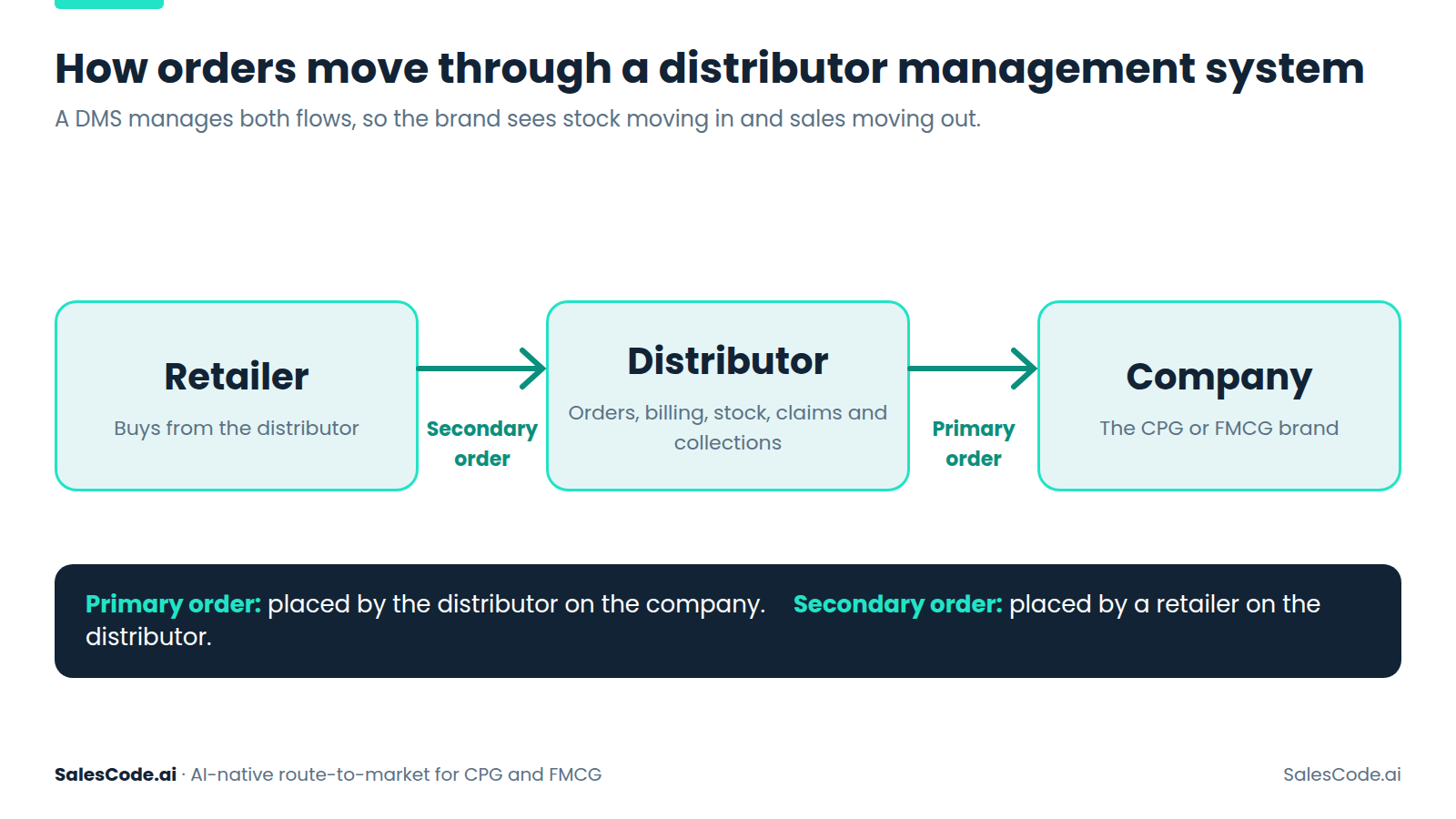
A distributor management system is the software a distributor uses to run daily business with the brand and with retailers. It manages two flows. A primary order goes from the distributor to the company. A secondary order goes from a retailer to the distributor.
A DMS typically manages:
- Orders and load-outs, for primary and secondary orders
- Invoices and bulk billing, including GST e-invoicing and e-way billing in India
- Stock at the distributor
- Schemes, promotions and claims
- Credit, ledgers and settlements
“Key takeaway: A traditional DMS records transactions. An AI-native DMS predicts, recommends and automates decisions.”
For the brand, the payoff is visibility: a real-time view of primary and secondary sales. SalesCode's AI-Native DMS is built around that view, and the Manager App connects to existing DMS environments through APIs.
Why is distributor management system adoption low?
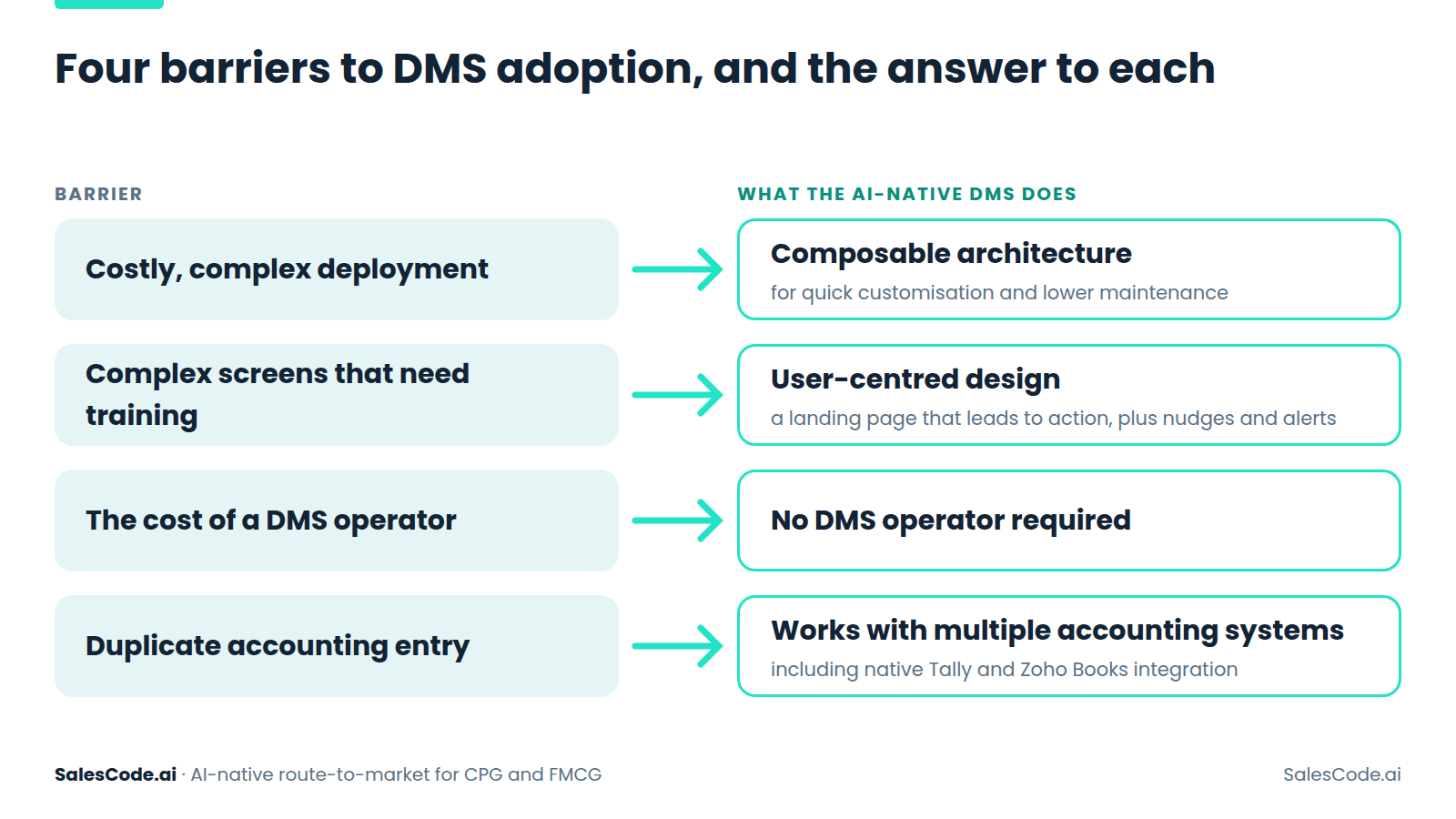
Adoption is low for 4 structural reasons. None of them is about the distributor's attitude.
- Monolithic architecture and complex workflows. Deployment, customisation and maintenance cost a lot, for the brand and for the distributor.
- Old, complex screens. They need training, which adds cost and slows adoption.
- The cost of an operator. A traditional DMS needs a person to operate it. For a small distributor, that cost makes a DMS unviable.
- Poor fit with accounting systems. If the DMS does not work with the accounting software a distributor already uses, the same entries are made twice.
“Key takeaway: Each barrier is a cost or an effort. Remove the cost and the effort, and DMS adoption stops being a persuasion problem.”
What does low DMS adoption cost an FMCG brand?
A DMS is only as useful as the data distributors put into it. When adoption is patchy, the brand pays in four ways:
- Incomplete secondary sales visibility. Sales to retailers are missing, so the brand sees only part of what is selling.
- Late stock-out signals. Without live stock data, SKU-level stock-outs can surface late, after sales are already lost.
- Manual claims and scheme reconciliation. Discounts are decided centrally, then applied, claimed and reconciled at the distributor. That is where money can leak.
- No base for prediction. Order and stock forecasts need transaction data. Thin data means weak forecasts.
This is why distributor adoption is a revenue question, not an IT question: the brand cannot plan inventory, working capital or promotions on data it only half has.
How does DMS software for FMCG fix low adoption?
The fix is to remove each barrier at the source. Here is how a distributor-friendly DMS answers the 4 barriers.
- Costly, complex deployment: Composable architecture for quick customisation and lower maintenance
- Complex screens: User-centred design: a landing page that leads to action, plus navigation assistance, nudges and alerts
- The cost of an operator: No DMS operator required
- Duplicate accounting entry: Compatible with multiple accounting systems, with native Tally and Zoho Books integration and multi-company operations
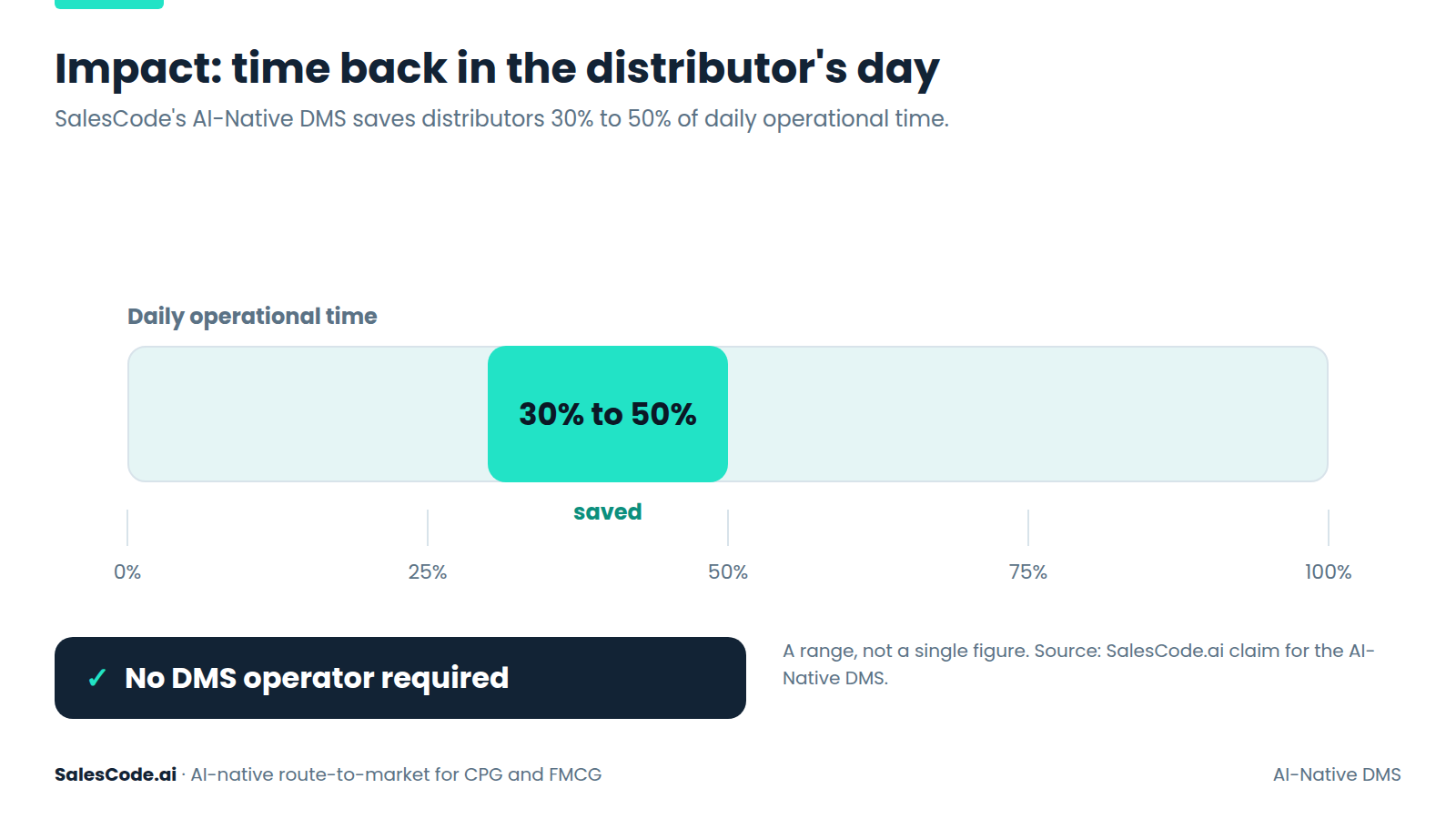
SalesCode's AI-Native DMS saves distributors 30% to 50% of daily operational time, and no DMS operator is required. For brands choosing DMS software for FMCG, those two facts address the cost and effort that keep adoption low.
What does an AI distributor management system add?
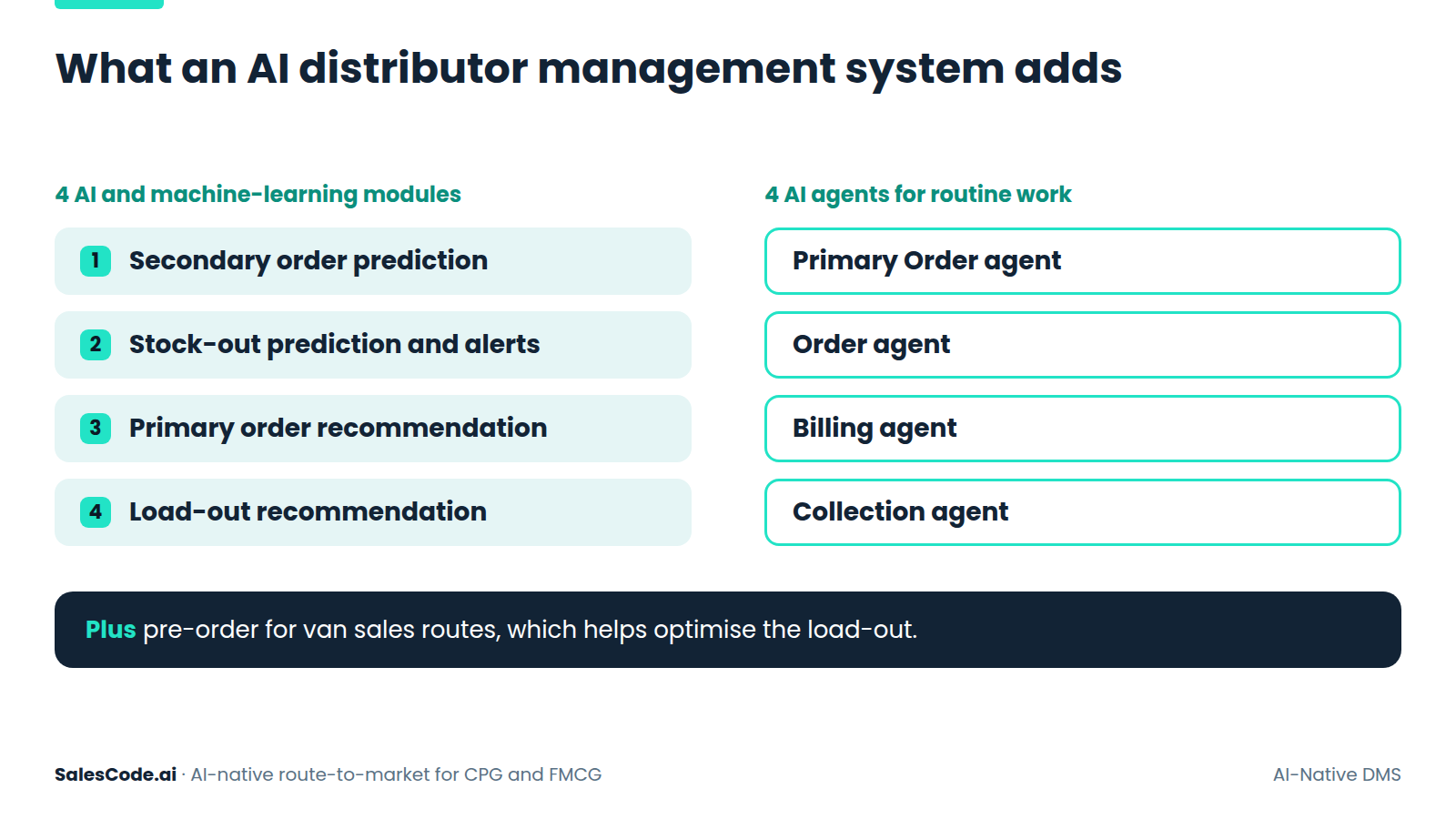
An AI distributor management system adds prediction on top of record-keeping. SalesCode's AI-Native DMS adds 4 AI and machine-learning modules that act before problems reach the distributor:
- Secondary order prediction, to plan inventory and working capital
- Stock-out prediction and alerts, at SKU level
- Primary order recommendation, based on predicted secondary orders, stock level, order cycle and fulfilment time
- Load-out recommendation, for ready-stock and van sales routes
It also supports pre-order for van sales routes, which helps optimise the load-out.
The DMS adds 4 AI agents that take over routine work: a Primary Order agent that places orders on the company, an Order agent that captures outlet orders on the distributor's behalf, a Billing agent and a Collection agent.
The DMS sits on the same platform as AI-Native SFA and AI-Native eB2B.
Can small distributors use a DMS?
Yes, when the DMS does not depend on a dedicated operator. The operator is one of the main reasons a DMS is unviable for small distributors: the software may be affordable, but the person to run it is not.
No DMS operator required. With a DMS for small distributors that works with the accounting software they already use, and screens designed around the next action, the distributor can run daily orders, billing and claims without hiring an operator.
“Key takeaway: A DMS for small distributors has to remove the operator cost, not just lower the licence price.”
How do you choose DMS software for FMCG?
Use these 6 questions to compare vendors. Each one targets a reason DMS rollouts stall.
- Does it need a dedicated operator, and what does that cost the distributor?
- Does it work with the accounting software your distributors already use, including multi-company set-ups?
- Can a new user find the next action without training?
- Does it predict orders and stock-outs, or only record them?
- Does it connect to your SFA and retailer ordering app, so secondary data flows without re-entry?
- Does it handle local compliance, such as GST e-invoicing and e-way billing in India?
“Key takeaway: If a vendor cannot answer questions 1 and 2 well, expect low distributor adoption whatever the feature list says.”
Frequently asked questions about distributor management systems
What is a distributor management system?
A distributor management system (DMS) is a software platform that runs a distributor's daily work: orders, billing, stock, claims and collections. It also gives the FMCG brand a view of primary orders (company to distributor) and secondary orders (distributor to retailer), so sales and stock are visible without waiting for reports.
Why is DMS adoption low among distributors?
DMS adoption stays low because traditional systems are expensive to deploy and maintain, need training on complex screens, require a dedicated operator that small distributors cannot afford, and duplicate entries distributors already make in their accounting software. These are cost and effort barriers, not attitude problems.
Can small distributors use a DMS?
Yes, if the DMS does not depend on a dedicated operator. The cost of an operator is one of the main reasons a DMS is unviable for small distributors. SalesCode's AI-Native DMS is built so that no DMS operator is required, which makes a DMS for small distributors practical.
Does a DMS work with Tally and other accounting software?
A good DMS works with the accounting software a distributor already uses, so entries are not duplicated. SalesCode's AI-Native DMS is compatible with multiple accounting systems, includes native Tally and Zoho Books integration, and supports multi-company operations on one platform.
What is the difference between primary and secondary orders in a DMS?
A primary order is placed by the distributor on the company. A secondary order is placed by a retailer on the distributor. A DMS manages both, so the brand can see stock moving into the distributor and sales moving out to retail.
How is an AI distributor management system different from a traditional DMS?
A traditional DMS records transactions. An AI distributor management system also predicts secondary orders, warns of stock-outs by SKU, recommends primary orders and load-outs, and automates routine billing and collection work, so the distributor acts on forecasts instead of reacting to last month's data.


