AI Native Digital Wallet for Payments and collections
Simplify retailer payments, invoice tracking and outstanding collections in one digital wallet, while giving commercial and finance teams real-time visibility from payment to reconciliation.
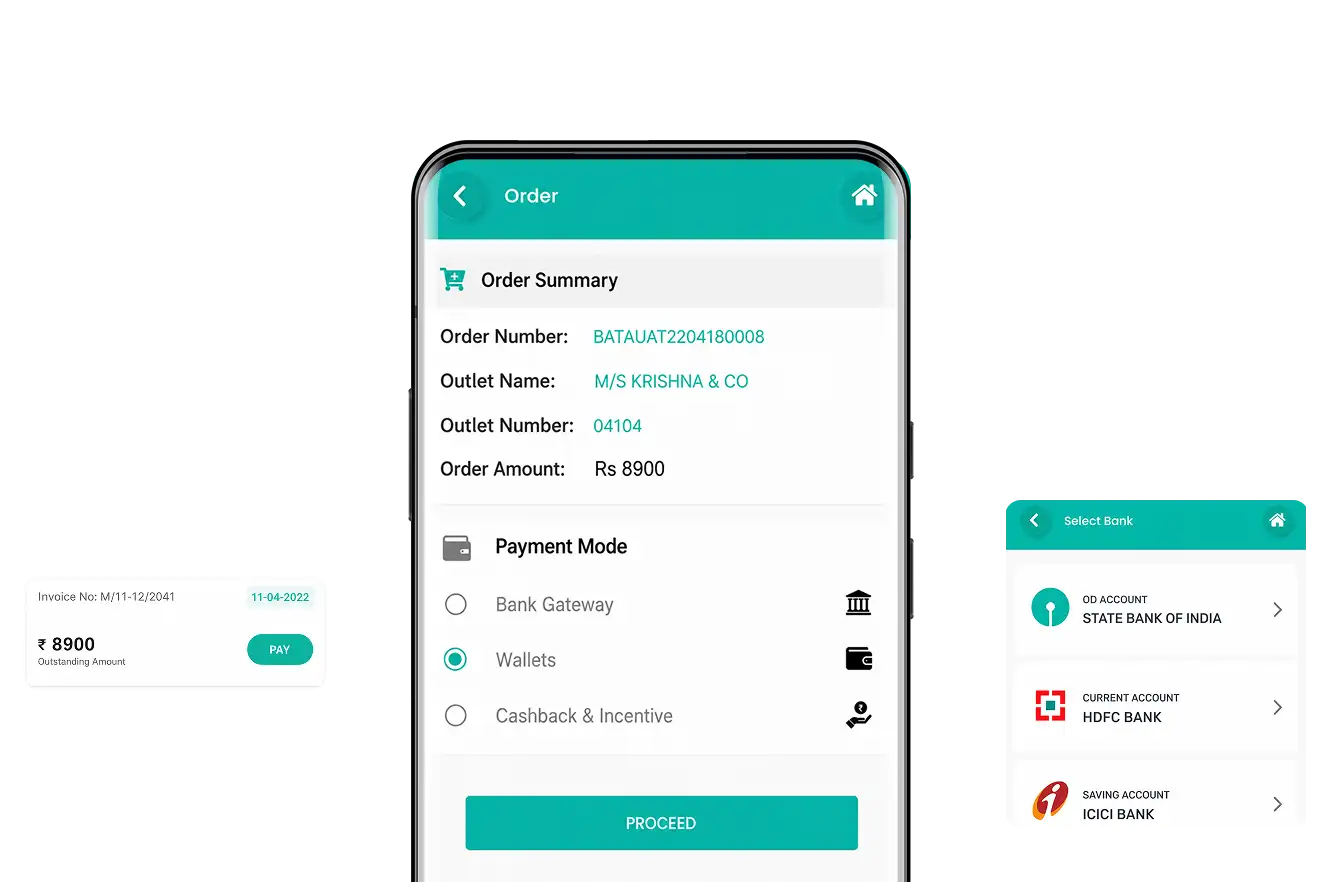
Today Payments Move In Seconds But Retailer Accounts Still Takes Months to Close
UPI has made digital payments simple. The real problem is matching every retailer payment to the correct invoice, outstanding balance and ledger across eB2B, field sales and distribution.
A Faster Path From Invoice to Settlement
Retailers see what they owe, choose the invoices they want to settle, pay digitally and receive instant confirmation. Every payment updates the correct account automatically.
Bring Every Invoice Into One View
Orders from eB2B, field sales and other channels appear in one retailer account with a clear delivery and payment status.
Show the Complete Amount Due
Retailers can view unpaid and partially paid invoices, credit notes, debit notes and the final payable balance in one place.
Select Invoices and Pay
The retailer chooses the invoices to settle and pays the exact amount through the available digital payment method.
Confirm and Reconcile Automatically
The payment is matched to the correct invoices, the outstanding balance is updated and finance receives a complete transaction record.
Capabilities built into the eB2B payments and invoices module

One combined order and invoice screen
A single list on a 15-day default window, with total outstanding amount for the selected range at the top. Search by invoice number. Sort by order date or invoice date, newest first.
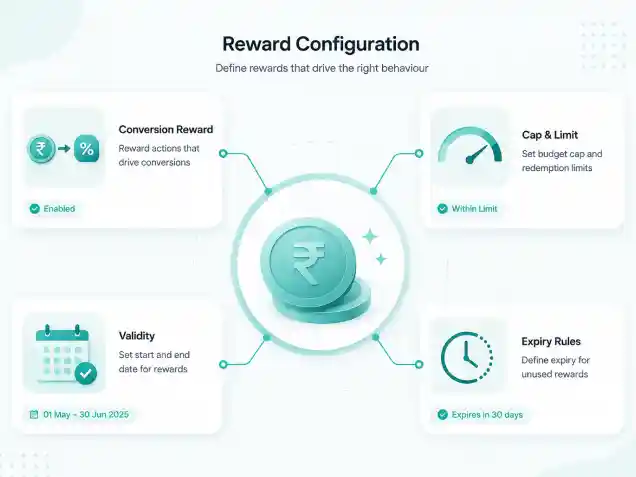
Three-state invoice cards
Order without invoice, invoice without order, or both. Missing values render as a dash rather than an empty field, so a retailer never reads a gap as a zero.
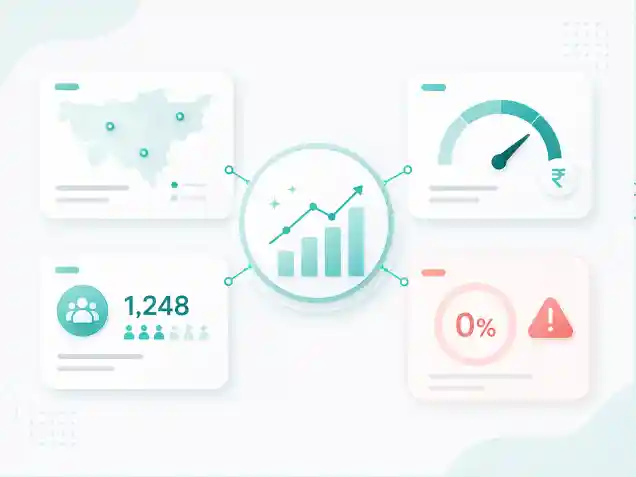
Credit note and debit note handling
CN and DN entries sit alongside invoices at header level: number, date, the order raised against, and total amount. They enter the payable calculation directly and are not held at item level.
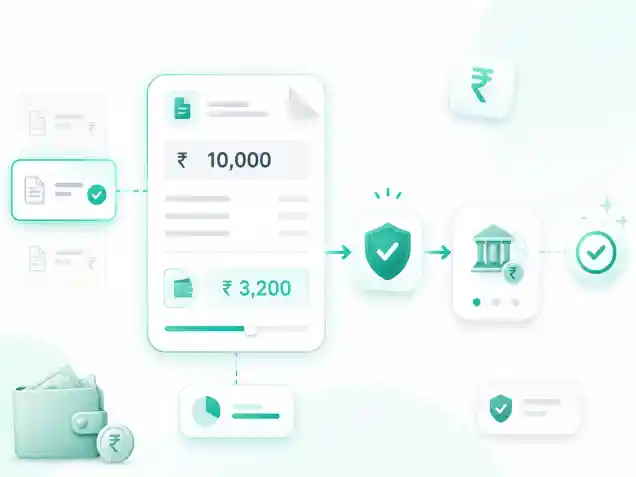
Partial payment against a single invoice
When exactly one invoice is selected, the retailer can enter an amount below the invoice total. The input is validated against the invoice amount before it reaches the gateway.
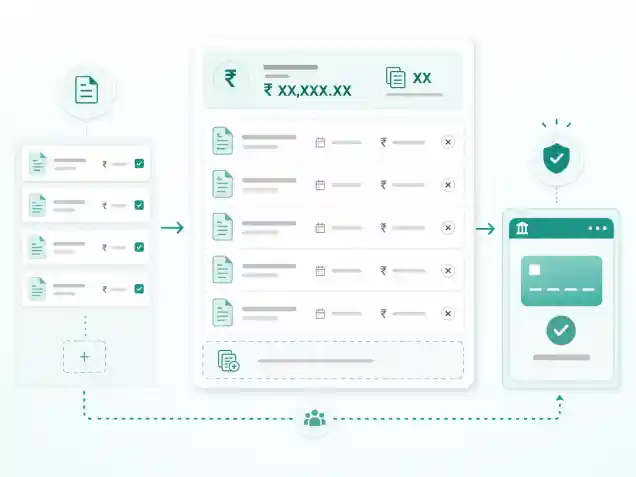
Multi-invoice settlement with a review step
No cap on invoices selected. A summary bar shows total payable and the invoice count, and expands into a sheet listing each selected invoice with its number, date, and amount, with a deselect action on every row.
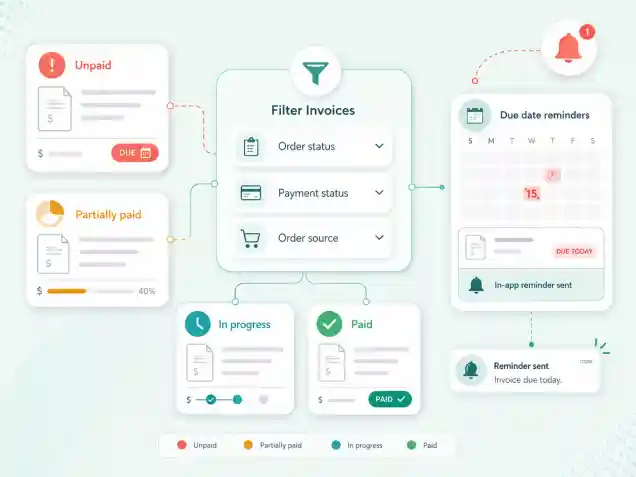
Filters, statuses, and due-date reminders
Filter by order status, payment status, and order source. Payment status covers unpaid, partially paid, in progress, and paid. In-app notifications fire against the invoice due date.
What the retailer sees on the My Orders screen
The retailer opens one screen. Total outstanding amount sits at the top for the selected date range. Each card carries the order number and date, the invoice number and date, the ordered and invoiced quantity in cases, the ordered and invoiced net amount, then voucher amount, discount, and tax, and finally the outstanding balance or final billed amount. Two tags run on every card: one for order source, eB2B or field rep, and one for order status. Tapping through to item level shows every SKU with its code, name resolved from the product master, quantity in cases, net price, SKU-level voucher, discount, and tax. Figures shown in product screenshots are illustrative interface examples, not performance claims.
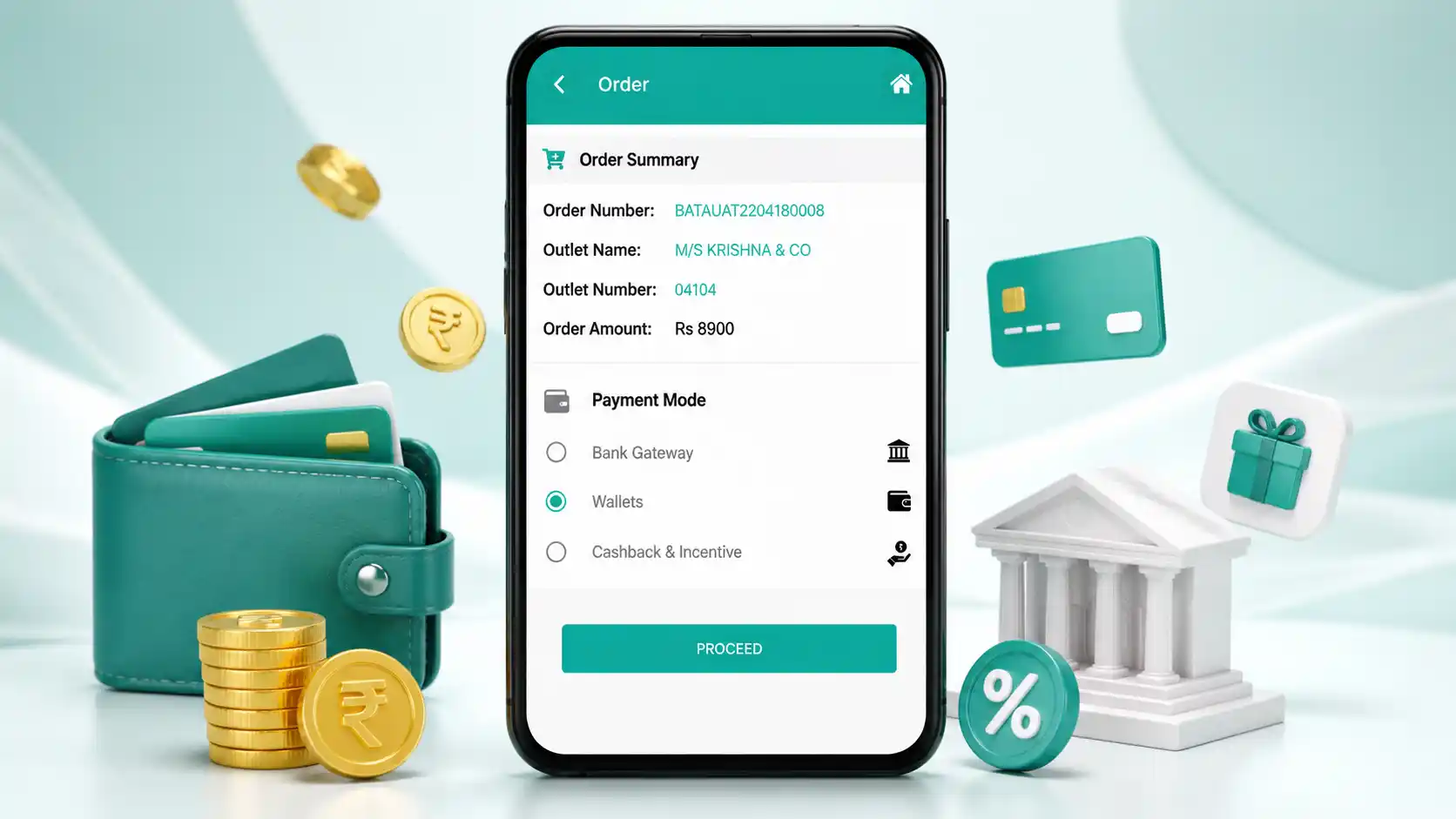
Reconciliation, credit control, and the pilot rollout
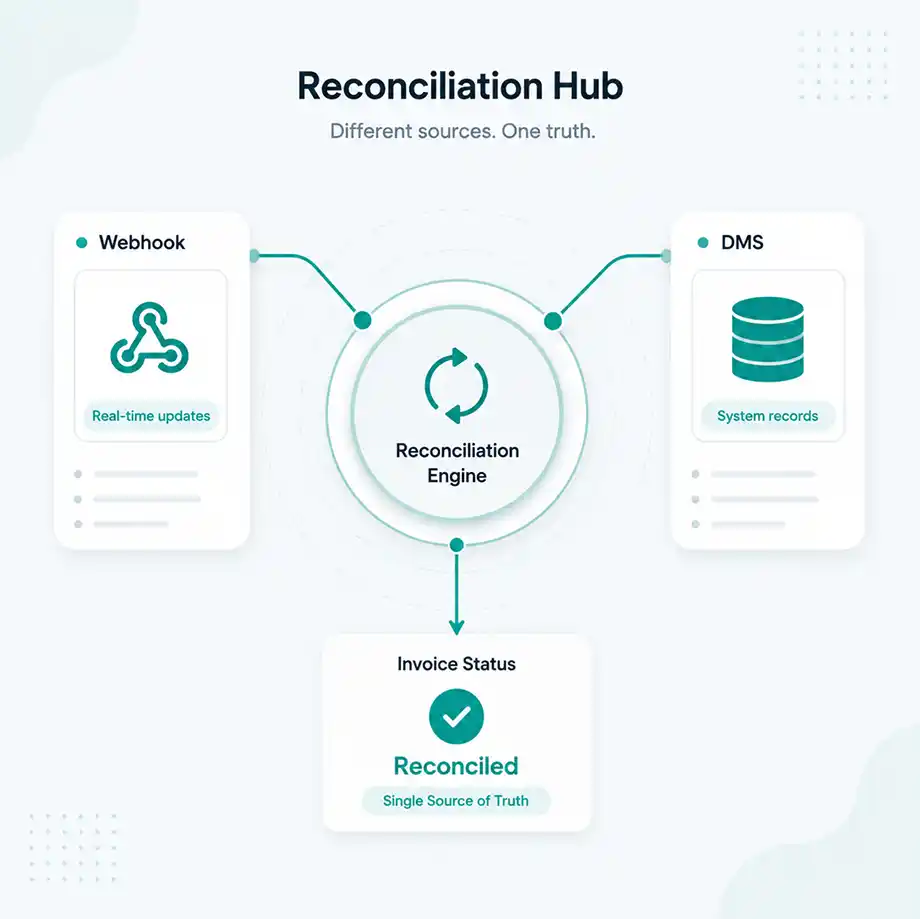
Payment status arrives from two directions. The gateway webhook updates the invoice in real time as in progress, paid, partially paid, or unpaid. The DMS covers what the webhook cannot see: settlements taken offline, and any sync gap. A daily incremental batch carries all pending and paid statuses since the last record, and a real-time delta fires the moment an invoice is settled at the DMS end.
Credit is exposed the same way. The DMS publishes customer credit limit, outstanding balance, available balance calculated as limit minus outstanding, and a last-updated timestamp, refreshed daily. Rollout is controlled: the payments module is released to a named list of distributor codes, so a bottler can pilot collection on one territory before opening it to the network.
















Questions about Digital Wallet
Retailers can select invoices, pay the exact amount digitally, and payments are automatically reconciled against those invoices.
It is not a consumer wallet holding a stored balance. It is the settlement layer between the retailer and distributor, keeping the retailer’s outstanding balance aligned with the distributor ledger and finance reconciliation.
Simply put, one is how money moves; the other is what the retailer sees and decides before it does. Both run on the same platform and retailer record, so all payments land in the same ledger.
This means payments are reconciled regardless of how the retailer pays—digitally, in cash to a rep, or through a bank transfer – so the outstanding balance stays accurate.
For multiple invoices, there is no cap on selection. A summary shows the total payable and item count, followed by a review screen with each invoice number, date and amount.
This gives retailers the flexibility to settle invoices based on their available cash flow, rather than being limited to full payment of a single invoice.
This ensures adjustments from returns, damages, schemes or short supply are automatically reflected in the final payable balance, so the retailer always sees an accurate outstanding amount.

Show Us a Better SFA, DMS or eB2B. Win 1 Million $.
Get a Big 4 firm to audit your platform against ours. Score higher on capability. We cut the cheque.


Open to any competing SFA, DMS or eB2B provider. Audit must be a Big 4 firm using a scorecard agreed with SalesCode.ai in advance.
AI Native Products
Image Recognition
Connectors
The AI-native route-to-market platform for CPG & FMCG enterprises — delivering a contractually guaranteed sales uplift, backed by IEEE peer-reviewed ML.
+91 8031152805
Mon–Fri · 10:00–19:00 IST
business@salescode.ai
Talk to our team
Social