
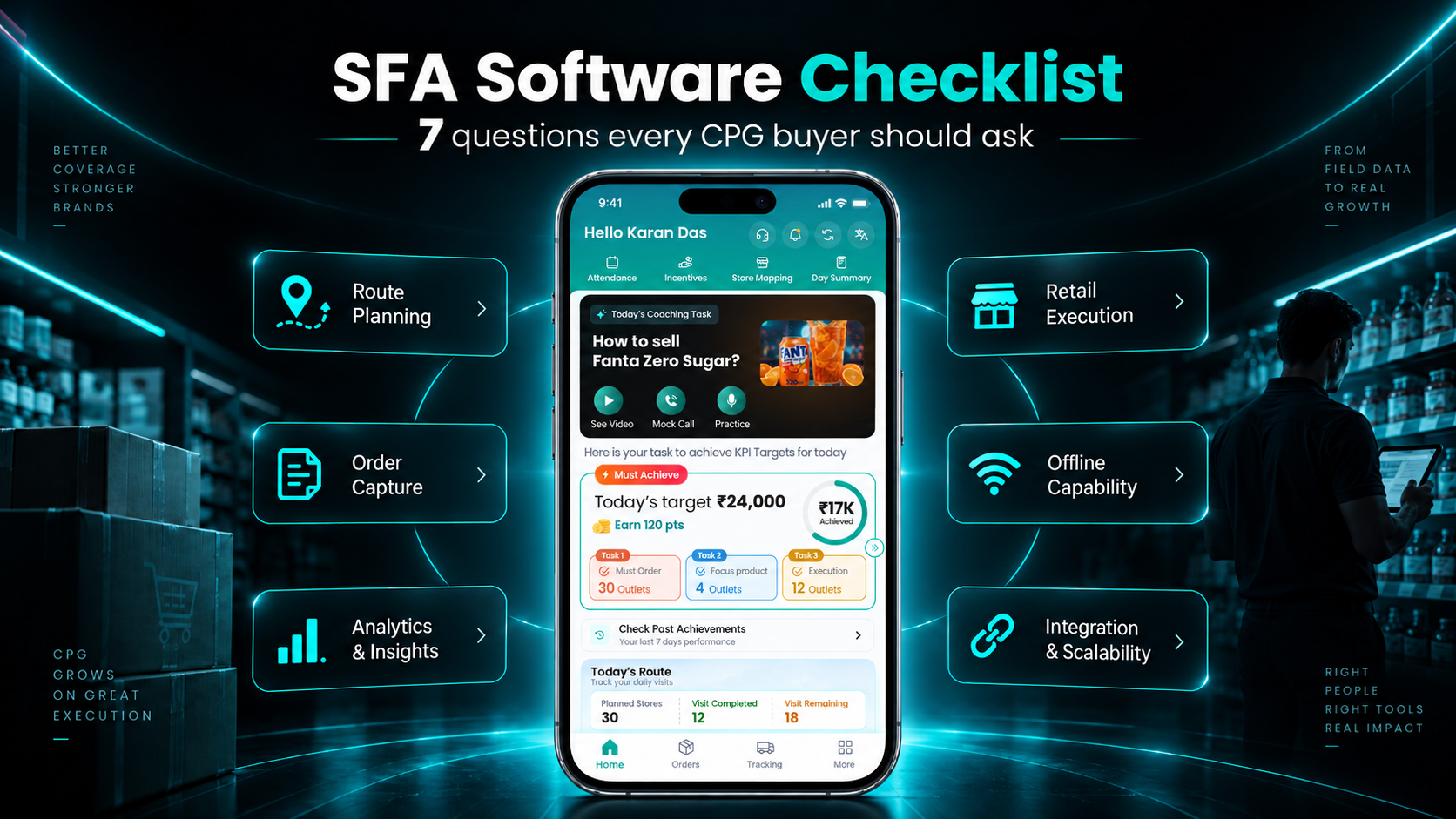
Most SFA evaluations are won by the best demo. Most SFA regrets are caused by the questions nobody asked.
An SFA evaluation checklist for CPG sales and IT leaders. Updated September 2026.
The best SFA software for CPG is not the one with the longest feature list or the slickest demo. It is the one a field force still uses six months after go-live, that owns secondary-sales data as well as primary orders, and whose total cost is what the vendor said it would be. Judged that way, the shortlist usually looks very different from the one built on feature checkboxes.
This is a practical SFA evaluation checklist: seven questions CPG buyers routinely forget to ask, the four lenses to score vendors on, and where the regret actually comes from. Ask these before the contract, not after the rollout stalls.
Key Takeaway
In Gartner's research on software-buyer regret, about 60% of buyers regretted a purchase made in the previous 18 months. The leading product-related reasons were higher-than-expected total cost and slow or difficult implementation, the two things a feature-led evaluation never tests.
What makes the best SFA software for CPG? (not the longest feature list)
Sales force automation is software that runs a field sales team's daily work: beat planning, in-store order capture, retail execution and reporting. The best SFA software for CPG is purpose-built for that job, which is why a general-purpose CRM bent into the same shape tends to fall short in the field. A purpose-built CPG SFA platform assumes thousands of outlets, offline territories, distributor hierarchies and shelf execution from day one. A CRM assumes a pipeline of deals.
The gap shows up on the exact capabilities a CPG field force lives on:
This is the difference between "can be configured to log field visits" and "was built for 3,000 reps working thousands of outlets, mostly offline." When buyers score the best SFA software on the second standard, the evaluation gets a lot more honest.
Why do CPG companies regret the SFA software they choose?The 4 lenses of an SFA evaluation checklist
Regret rarely comes from a missing feature. It comes from the parts of the deal a feature-led evaluation never tested: what it actually costs over three years, how hard it is to implement, and whether the handoff from sales to delivery holds. Gartner's research on software-buyer regret puts numbers on it, and every one of these drivers maps to a question buyers forgot to ask.
Source: Gartner research on software-buyer regret. Handoff and expectations are the top vendor-related factors; cost and implementation the top product-related reasons.
Read the chart as a warning list. Total cost, implementation and the sales-to-delivery handoff cause most of the regret, and all three are invisible in a demo. The checklist below is built to drag them into the open before a signature, not after.
The 4 lenses of an SFA evaluation checklist
Before the seven questions, agree on what you are scoring. Every SFA evaluation reduces to four lenses. The seven questions each sit under one of them, so a vendor that dazzles on features but fails a lens still fails the evaluation.
Will the field force still use it after the novelty wears off, online or offline?
Does it own outlet, distributor and secondary-sales data and talk to ERP, DMS and CRM?
Is the AI real (prediction, on-device image recognition, agents) or a bolt-on label?
What is the 3-year cost, and who owns implementation, migration and change management?
How to use it
Score every shortlisted vendor on all four lenses, then weight them for your business. The best SFA software is the one that clears the lens you are weakest on today, not the one that demos best.
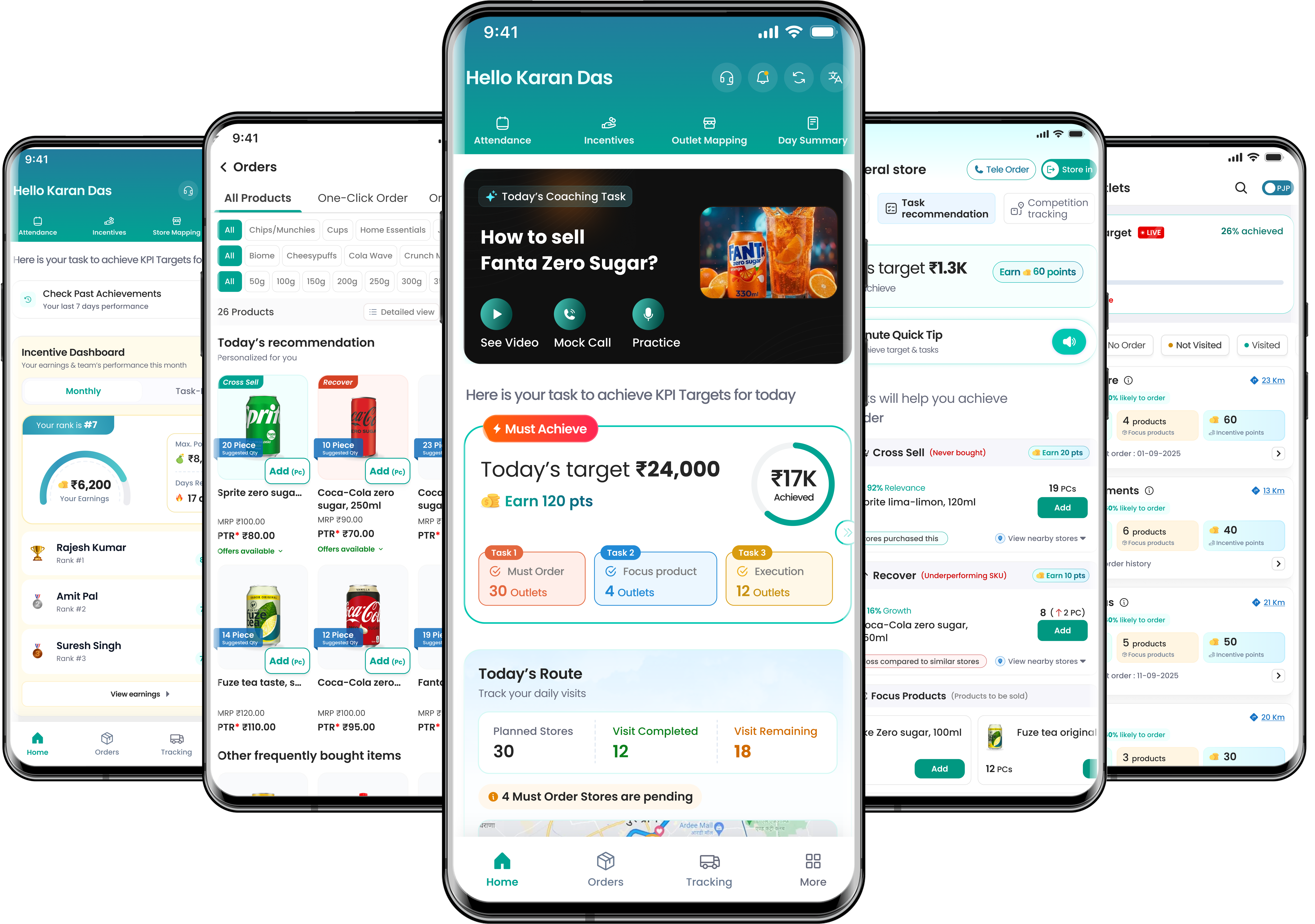
The 7 questions CPG buyers forget to ask
Put these to every shortlisted vendor, in writing, and make them answer with evidence rather than adjectives. Each maps to one of the four lenses, so a strong or weak answer moves a real score.
What is your field-force adoption rate at 6 months, not week one?
Week-one logins prove nothing. Ask for sustained daily-active usage from a comparable CPG rollout. A weak answer quotes pilot enthusiasm and goes quiet on month six.
Lens: Adoption & usabilityDoes it work fully offline, and what happens to orders when the rep reconnects?
Most CPG territories lose signal. "We have an offline mode" is not enough: ask how orders, visits and images queue and sync, and what happens in a conflict.
Lens: Adoption & usabilityHow do you handle our secondary sales and distributor data, not just primary orders?
Primary orders are the easy half. If the platform cannot see secondary sales through the distributor management system, you are blind to what actually sells through.
Lens: Data & integrationWho owns data cleanup and migration, and is it scoped and priced before go-live?
This is where rollouts quietly die. If the answer is "your team exports a spreadsheet," the migration is unowned and the timeline is fiction.
Lens: Data & integrationIs image recognition on-device, and what is the accuracy on our actual SKUs?
Cloud-only IR fails in a low-signal store. Ask for on-device recognition and a measured accuracy figure on your own packs, not a generic benchmark.
Lens: IntelligenceWhat is the 3-year total cost of ownership, not just the per-user licence?
Higher-than-expected total cost is the number-one driver of buyer regret. Get implementation, support, integrations and change management into one 3-year figure before you compare prices.
Lens: Total cost & deliveryWhat is on the AI roadmap, and will we be on it or stuck on a legacy version?
AI capability is moving fast. Ask what ships in the next 12 months, whether existing customers get it, and how a unified SFA, DMS and eB2B platform avoids leaving you on an orphaned build.
Lens: Intelligence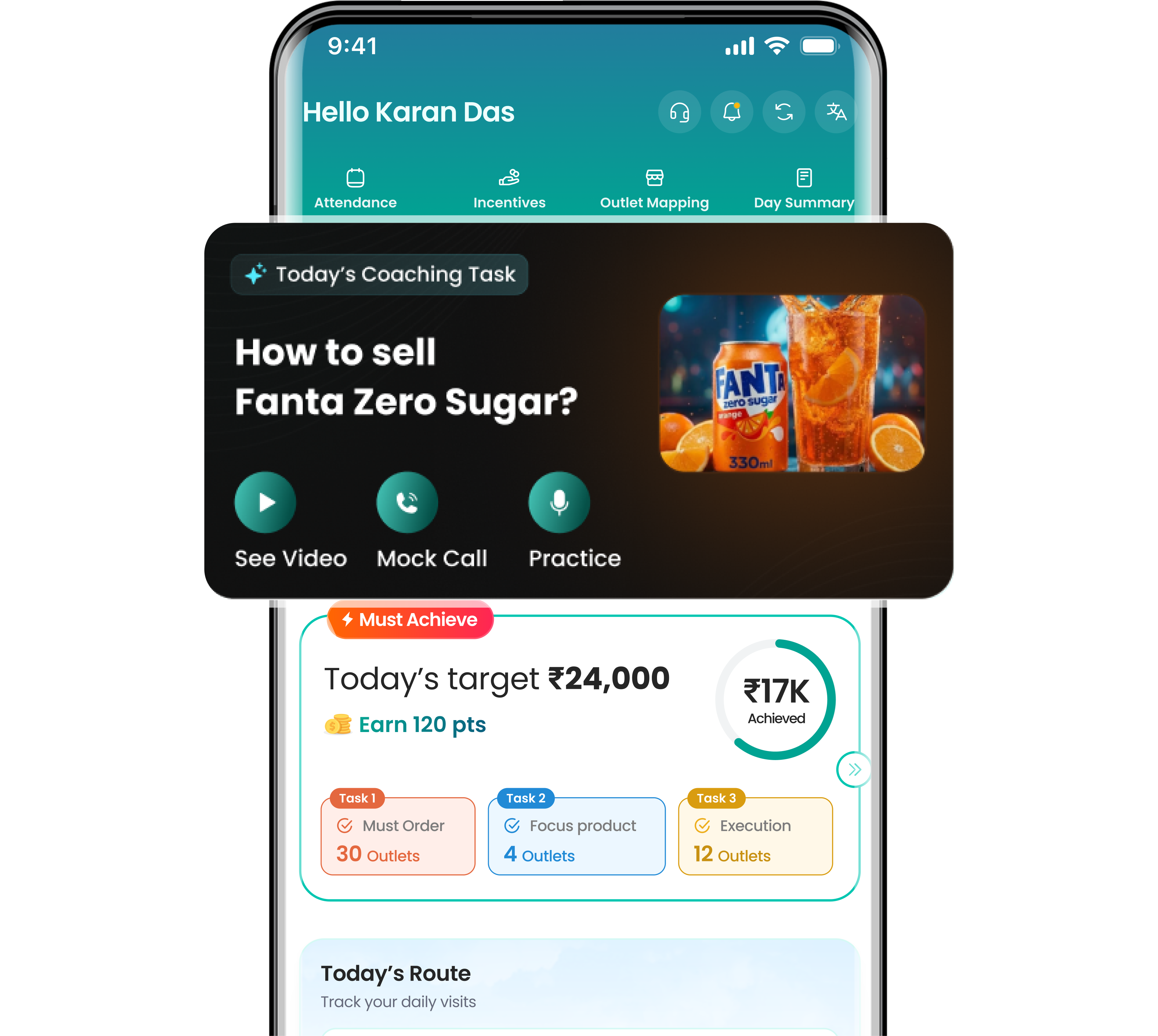
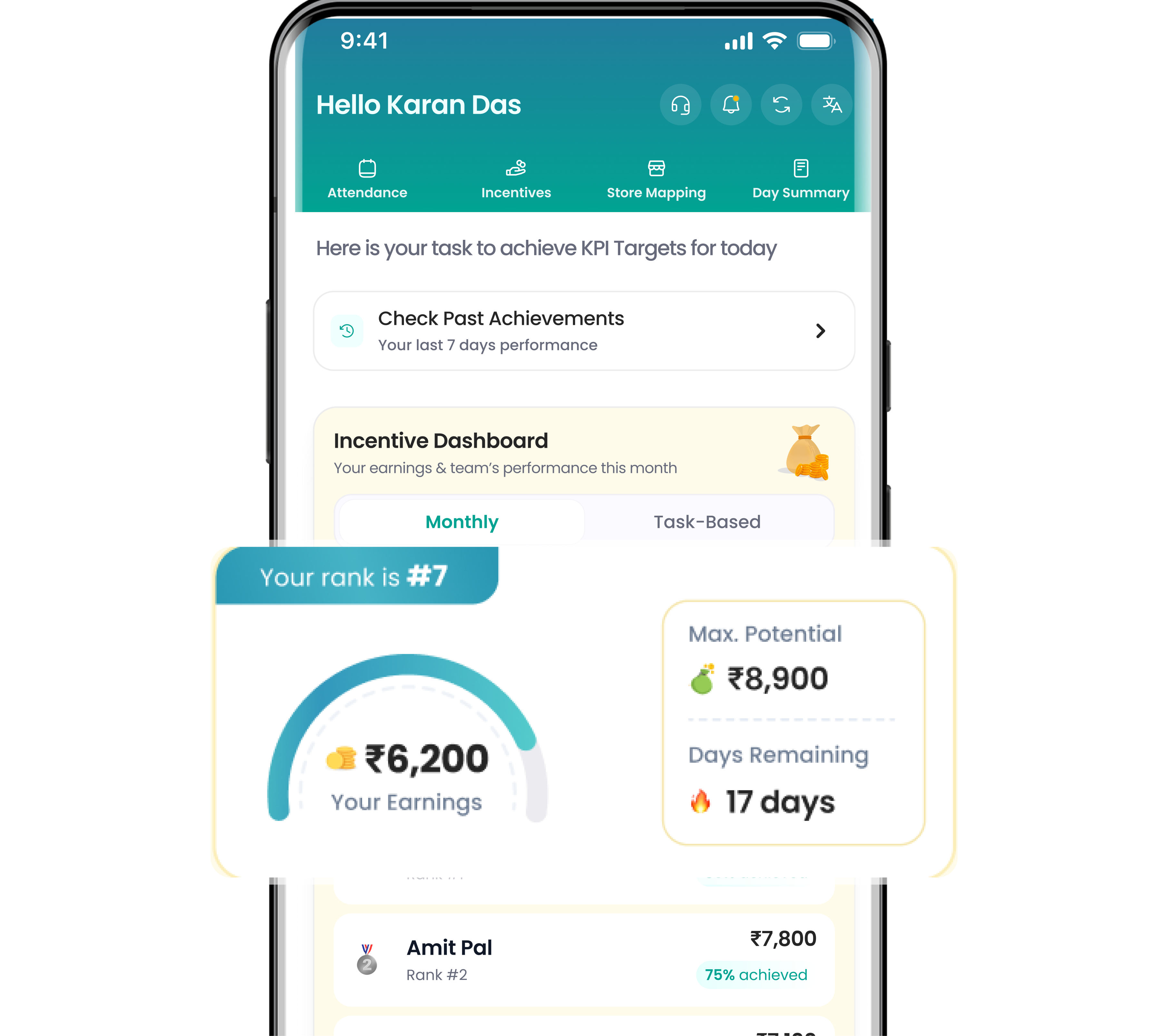
Frequently asked questions about choosing the best SFA software
What is the best SFA software for CPG?
There is no single winner for every company. The best SFA software for CPG is the one your field force actually adopts, that owns secondary-sales and distributor data alongside primary orders, works offline, and whose three-year total cost matches the quote. Score vendors on four lenses: adoption, data and integration, intelligence, and total cost and delivery.
What should an SFA evaluation checklist include?
Seven questions most buyers forget: six-month adoption rate, offline operation and sync, secondary sales and distributor data, who owns data migration, on-device image-recognition accuracy on your SKUs, three-year total cost of ownership, and the AI roadmap. Together they test adoption, data, intelligence and cost, not just features.
What is the difference between SFA and CRM for field sales?
SFA is purpose-built for field and retail execution: beat planning, in-store order capture, offline operation, image recognition and secondary-sales visibility. A CRM is built for pipeline and opportunity management. A generic CRM adapted for field sales usually lacks offline capture, retail execution and distributor data, which is why CPG teams outgrow it.
Why do CPG companies regret their SFA purchase?
Gartner research found about 60% of software buyers regret a recent purchase, with the leading reasons being higher-than-expected total cost and slow or difficult implementation, plus a poor handoff from sales to delivery. Feature-led evaluations miss all three, so buyers under-test cost, adoption and implementation.
How long does SFA implementation take?
A standard SFA deployment typically runs 6 to 12 weeks. A highly customized, enterprise-wide rollout can take 3 to 6 months. Ask each vendor to name who owns data migration and change management, since slow implementation is a top cause of buyer regret.
How is SFA software priced?
Most SFA software is priced per user per month, with a separate implementation and onboarding fee. Compare vendors on three-year total cost of ownership, not the per-seat licence alone, and include support, integrations and change management so the number you compare is the number you will actually pay.
Run the checklist against SalesCode.
Bring the seven questions to a working session and see how an AI-native SFA, DMS and eB2B platform answers each one with evidence.
Book a Demo


